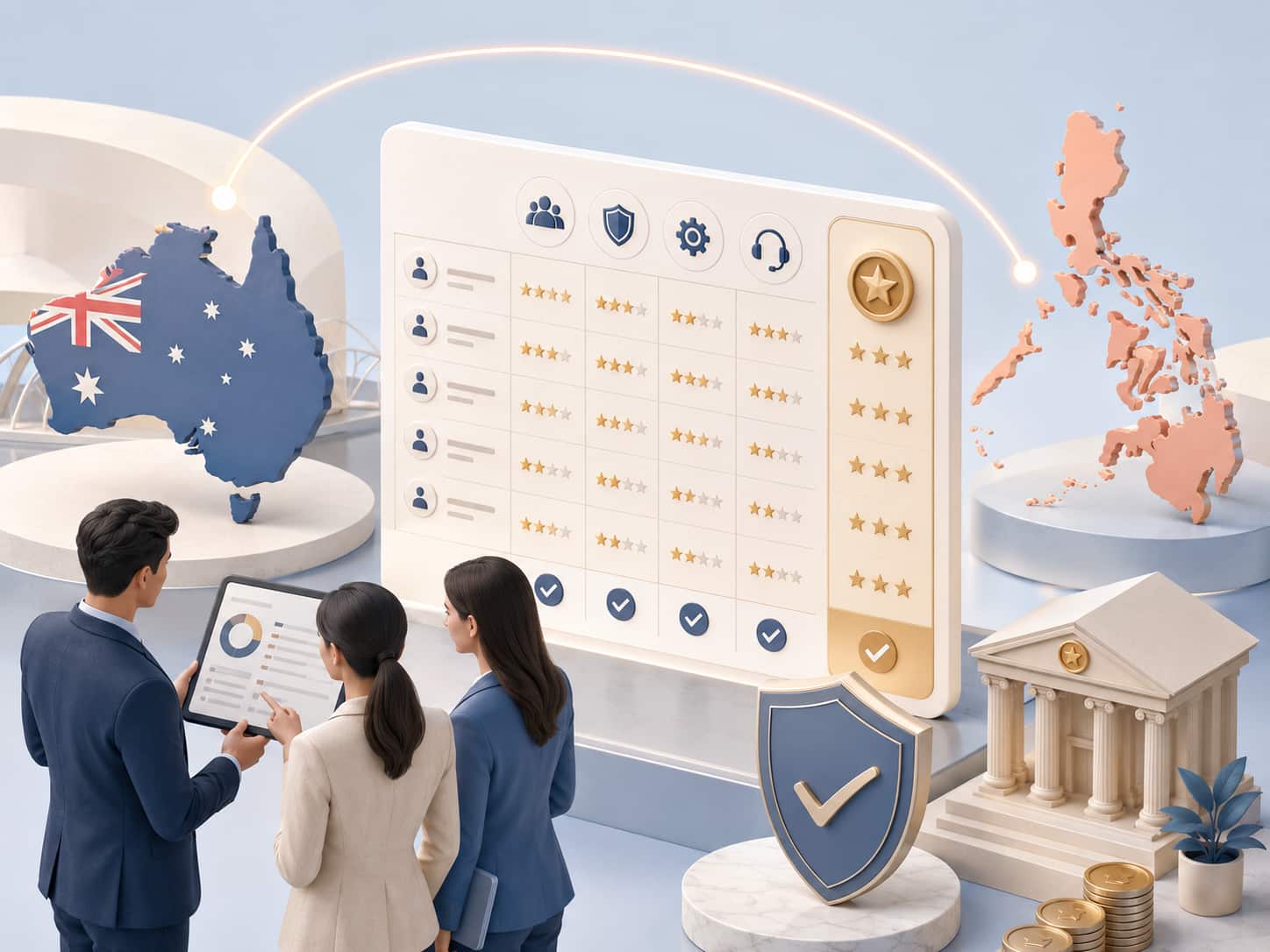
How Australian Financial Services Companies Build Offshore Teams in the Philippines
Author: Martin English
Published: June 4, 2026
Australian financial services companies are building offshore teams in the Philippines to support paraplanning, client services, financial planning administration, mortgage processing, accounting support, compliance administration and back-office operations.
The strongest offshore teams are not built by hiring random offshore staff and adding tasks later. They are built around clear workflows, safe system access, defined role boundaries, Australian review processes and a workforce model that matches how the team will actually work.
Direct answer: Australian financial services companies build offshore teams in the Philippines by identifying repeatable support workflows, choosing suitable roles such as paraplanners, CSOs, planning administrators, mortgage processors or finance support staff, selecting the right hiring model, setting data and compliance controls, onboarding staff carefully and scaling only after the first workflow is stable. EOR is often suitable where the firm wants dedicated Philippine employees without setting up its own local entity.
This guide is for Australian financial planning firms, mortgage brokers, accounting firms, wealth practices, fintechs and financial services companies planning a structured offshore team in the Philippines.
EOR is one possible employment structure. This page focuses on the broader offshore-team system: role sequencing, workflow design, compliance controls, onboarding, performance management and scaling.
For the EOR hiring pathway, read Employer of Record for Australian Financial Services Companies Hiring in the Philippines.
TL;DR: Building Offshore Teams in the Philippines for Australian Financial Services
| Question | Practical Answer |
| Why build in the Philippines? | Many financial-services support roles are process-driven, document-heavy and suitable for remote delivery with the right controls. |
| What roles work well? | Paraplanners, CSOs, planning administrators, mortgage processors, bookkeepers, accountants, finance assistants and compliance admin support. |
| What should stay in Australia? | Advice, strategy, client recommendations, final sign-off, licensee oversight and regulated judgement. |
| What is the best first hire? | Start with the workflow causing the clearest bottleneck, often planning admin, CSO, paraplanning support or mortgage processing. |
| Is EOR suitable? | Yes, where staff are dedicated, ongoing, supervised and integrated into the firm’s workflows. |
| Is BPO better? | BPO may fit if the firm wants provider-managed outputs rather than named dedicated employees. |
| What controls are needed? | Role scope, system permissions, Privacy Act/APP review, templates, QA, escalation rules and audit trails. |
| How should teams scale? | Prove one workflow first, then add complementary roles, team leadership and performance reporting. |
Find the Right Offshore Team Guide
Use this pillar as the starting point, then move to the guide that matches your next decision.
| If You Need Help With… | Read This Next |
| EOR structure for Australian financial services teams | Employer of Record for Australian Financial Services Companies Hiring in the Philippines |
| Hiring Client Services Officers | Hire Client Services Officers in the Philippines for Australian Financial Planning Firms |
| Hiring financial planning administration staff | Hire Financial Planning Administration Staff in the Philippines |
| Choosing between EOR, BPO and staff leasing | Employer of Record vs Staff Leasing vs BPO |
| Understanding contractor classification | Contractor vs Employee in the Philippines |
| Reviewing contractor misclassification risk | Contractor Misclassification in the Philippines |
| Modelling contractor-to-employee costs | Hourly Freelancers to Salaried Employees in the Philippines: Cost Modelling Playbook for CFOs |
Who This Guide Is For
| Australian Business Type | Common Offshore Team Roles |
| Financial Planning Firms | Paraplanners, CSOs, planning administrators, implementation support |
| Mortgage Brokers | Mortgage processors, loan admin, client follow-up staff |
| Accounting Firms | Bookkeepers, accountants, SMSF support, reporting assistants |
| Wealth Management Firms | Client service, document preparation, workflow and reporting support |
| Fintech Companies | Customer support, operations support, QA and finance administration |
| Licensee or Dealer Group Support Teams | File review assistance, compliance administration, adviser support workflows |
This page is a strategic guide for building the offshore team. For individual roles, use the role-specific pages linked throughout the article.
Why Australian Financial Services Firms Use SOS for Philippines Offshore Teams
Smart Outsourcing Solution supports 1,000+ employees across 250+ global clients, including 30+ Australian accounting and financial-services firms. This experience informs the role scoping, EOR structure, payroll support and offshore-team planning frameworks used in this guide.
For Australian financial services firms, SOS can help with:
- Offshore team planning for paraplanning, CSO, planning admin, mortgage, finance and support roles.
- Philippine employment through an EOR model.
- Payroll, payslips and employment administration.
- Benefits coordination and employee support.
- Contractor-to-employee transition planning.
- Role-by-role cost modelling.
- Dedicated account management for ongoing support.
Why Australian Financial Services Firms Build Offshore Teams in the Philippines
Australian financial services firms often look offshore when local teams are overloaded by administration, documentation, compliance process work or recurring client-service tasks.
Common drivers include:
- Adviser and senior staff time being absorbed by administration.
- Slower turnaround on documents, implementation and follow-ups.
- Difficulty hiring local support staff in Australia.
- Rising operating costs across advice, mortgage and accounting teams.
- Need for dedicated support staff trained in firm-specific workflows.
- Contractor or freelancer arrangements becoming too informal for long-term roles.
- Desire to scale without setting up a Philippine entity.
- Need for better workflow visibility and task ownership.
The Philippines can be a strong location for support roles, but only when the offshore model is designed around quality, compliance boundaries and management readiness.
What Work Should Australian Financial Services Firms Offshore First?
The best offshore starting point is usually repeatable work with clear inputs, outputs, templates and review owners.
| Workflow Bottleneck | Good First Offshore Role | Why It Works |
| Advisers spend too much time on file preparation | Financial Planning Administrator | Repeatable, document-heavy and easy to review |
| Client follow-ups are inconsistent | Client Services Officer | Improves client-service workflow without moving advice responsibility |
| Paraplanners receive incomplete files | Planning Admin or CSO | Improves file readiness before technical work starts |
| SOA/ROA preparation is delayed | Paraplanning Support | Adds technical support under adviser review |
| Mortgage files are slow to progress | Mortgage Processor | Process-driven, document-heavy and status-based |
| Accounting deadlines create backlogs | Bookkeeper or Accounting Support | Recurring workflow with clear review standards |
| Compliance checklists are inconsistent | Compliance Administration Support | Supports evidence tracking and file completeness |
| Operations lacks visibility | Operations Assistant or Coordinator | Improves task boards, reports and workflow rhythm |
Start with one bottleneck. Avoid hiring several offshore roles before the firm has proven onboarding, review and communication processes.
Best Roles for Australian Financial Services Offshore Teams in the Philippines
| Role | Typical Tasks | Best Fit |
| Paraplanner | SOA/ROA support, research packs, modelling support, adviser review preparation | Firms with advice-document bottlenecks |
| Client Services Officer | Client follow-ups, implementation tracking, CRM updates, adviser support | Firms needing stronger client-service workflow |
| Financial Planning Administrator | File preparation, meeting packs, CRM hygiene, workflow tracking | Firms with admin-heavy advice processes |
| Mortgage Processor | Loan document collection, file packaging, lender follow-ups | Mortgage brokers and lending teams |
| Bookkeeper / Accounting Support | Reconciliations, workpapers, reporting support, admin | Accounting and finance teams |
| Finance Assistant | Invoice support, reporting admin, reconciliation support | Finance operations teams |
| Compliance Administration Support | File completeness, checklist tracking, evidence collation | Firms needing stronger compliance process support |
| Operations Assistant | Scheduling, reporting, task coordination, process tracking | Growing offshore teams needing operational rhythm |
Related guides:
- Hire Paraplanners in the Philippines – 2026 Guide
- Hire Client Services Officers in the Philippines for Australian Financial Planning Firms
- Hire Financial Planning Administration Staff in the Philippines
- Best Roles Australian Financial Planning Firms Hire in the Philippines
- Cost to Hire Financial Planning Support Staff in the Philippines
What Should Stay With the Australian Team?
An offshore team should increase capacity, not blur regulated responsibility.
| Area | Should Remain With Australian Team |
| Personal Advice | Final advice and client recommendations |
| Strategy Selection | Advice strategy, product selection and suitability |
| SOA / ROA Final Approval | Adviser or authorised reviewer sign-off |
| Client Advice Meetings | Regulated advice delivery and judgement-based client conversations |
| Compliance Sign-Off | Final compliance review and remediation decisions |
| Client Complaints | Complaint handling and regulatory response |
| Fee and Service Decisions | Advice fees, service-package changes and client agreement decisions |
| Complex Client Judgement | Any decision requiring licensed, authorised or professional judgement |
| Data and Access Governance | Internal policy, permissions and client-data controls |
Offshore staff can support preparation, process and administration. Australian advisers, licensees, managers and authorised staff should retain appropriate control over advice, client obligations and final review.
Choosing the Right Offshore Hiring Model
Australian financial services firms usually compare four options.
| Model | How It Works | Best Fit | Watch-Out |
| Employer of Record | EOR locally employs dedicated Philippine staff while the Australian firm manages daily work | Dedicated roles without setting up a Philippine entity | Provider scope, payroll evidence and employee support must be clear |
| Contractor / Freelancer | Individual provides independent services | Project-based or genuinely independent work | Risk increases if the person works like staff |
| BPO / Managed Service | Provider manages a process or output | Firm wants provider-owned delivery and staffing | Less direct control over named employees |
| Own Philippine Entity | Australian firm sets up its own local operation | Large, mature, long-term Philippine workforce | More setup, payroll, HR and compliance administration |
For many Australian financial services firms, EOR sits between informal contracting and full entity setup. It can suit dedicated, supervised staff who are part of the firm’s long-term operating model.
For the employment model pathway, read Employer of Record for Australian Financial Services Companies Hiring in the Philippines.
For broader model comparison, read Employer of Record vs Staff Leasing vs BPO.
When EOR Is a Strong Fit
EOR may fit where the offshore worker is not an external project supplier but a dedicated team member.
| Indicator | Why It Points Toward EOR |
| Role is ongoing | Work is part of the firm’s operating model |
| Worker is dedicated | Person supports one firm rather than several clients |
| Firm manages daily work | The Australian team sets priorities and reviews output |
| Staff use firm systems | CRM, document, workflow or platform access is required |
| Work follows internal SOPs | Role is integrated into company process |
| Firm wants retention | Employee experience and benefits matter |
| Entity setup is not justified | The firm wants staff without creating a Philippine company |
For contractor classification guidance, read Contractor vs Employee in the Philippines.
For risk detail, read Contractor Misclassification in the Philippines.
Offshore Team Build Sequence
A safe offshore team grows in stages, not all at once.
| Stage | Team Shape | Goal |
| Stage 1: First Workflow | One planning admin, CSO, mortgage processor or finance support hire | Prove onboarding, task ownership and review rhythm |
| Stage 2: Complementary Role | Add the role that removes the next bottleneck | Improve handoffs and workflow coverage |
| Stage 3: Functional Pod | Build a small role-specific pod such as CSO + planning admin + paraplanning support | Create deeper function ownership |
| Stage 4: Quality Layer | Add QA, senior reviewer, team lead or operations coordinator where needed | Reduce manager load and improve consistency |
| Stage 5: Scaled Offshore Model | Expand across planning, mortgage, accounting, finance or operations | Build stable offshore capability with reporting and governance |
This sequence keeps the firm from adding headcount faster than its systems, review processes and managers can support.
Offshore Team Structure Examples
Example 1: Financial Planning Admin Pod
| Role | Purpose |
| Financial Planning Administrator | File preparation, CRM updates, meeting packs and workflow tracking |
| Client Services Officer | Client follow-ups and implementation coordination |
| Australian Adviser / Practice Manager | Review, sign-off, client relationship and oversight |
Best for firms with admin-heavy advice workflows and slow client-service turnaround.
Example 2: Advice Support Pod
| Role | Purpose |
| Planning Administrator | File completeness and document preparation |
| Paraplanning Support | SOA/ROA preparation support and research packs |
| Australian Adviser / Authorised Reviewer | Advice decisions, review and final sign-off |
Best for firms with paraplanning backlog and incomplete file preparation.
Example 3: Mortgage Processing Pod
| Role | Purpose |
| Mortgage Processor | Document collection, loan file packaging and lender follow-up |
| Client Support Assistant | Client updates and missing-information tracking |
| Australian Broker | Client advice, lending recommendation and final submission review |
Best for brokers with high-volume loan documentation and follow-up requirements.
Example 4: Accounting and Finance Support Pod
| Role | Purpose |
| Bookkeeper / Accounting Support | Reconciliations, workpapers and reporting preparation |
| Finance Assistant | Invoice and admin support |
| Australian Accountant / Manager | Review, client judgement and final approval |
Best for accounting firms or finance teams with recurring back-office workload.
Who Should Manage the Offshore Team Internally?
A strong offshore team needs a clear Australian owner. The EOR or provider can support employment administration, but daily workflow ownership should sit with the business.
| Internal Owner | Best Fit |
| Practice Manager | Financial planning admin, CSO and operations support roles |
| Adviser or Associate Adviser | Paraplanning, file preparation and advice workflow support |
| Mortgage Broker or Lending Manager | Mortgage processing and client follow-up roles |
| Accounting Manager | Bookkeeping, reporting and accounting support roles |
| Operations Manager | Multi-role offshore pods and workflow reporting |
| Compliance Manager | Compliance administration, checklist tracking and evidence workflows |
The internal owner should define priorities, review work, provide feedback and decide when the role is ready to expand.
Compliance, Privacy and Data Controls
Australian financial services companies should treat offshore access as a controlled operating model.
| Control Area | What to Define |
| Privacy Act and APPs | How offshore access to client personal information aligns with privacy obligations and disclosures |
| Offshore Client Data Access | What information offshore staff can access, store, update, download or send |
| Licensee / AFSL Oversight | How delegated work is supervised, reviewed and signed off |
| Advice Boundaries | Offshore staff should not make advice, strategy or product decisions unless properly authorised |
| System Permissions | CRM, platform, email and document access based on role need |
| Client Communication | Which messages can be sent directly and which need adviser approval |
| Document Handling | File naming, storage, version control and deletion rules |
| Device Security | MFA, password rules, device controls and secure networks |
| Audit Trail | Records of tasks, reviews, approvals and client-file updates |
| Incident Escalation | What happens if client information is mishandled or a process error occurs |
| Access Removal | Immediate removal when staff leave or roles change |
EOR supports the employment structure. It does not replace Australian financial services compliance, privacy governance, licensee oversight or adviser supervision.
Cost Model for an Australian Financial Services Offshore Team
The cost of an offshore team should be modelled role by role, not as one generic offshore salary.
| Cost Component | What It Covers |
| Base Salary | Monthly salary for each Philippine employee |
| Employer-Side Costs | Applicable local employment costs |
| 13th-Month Pay Accrual | Annual payroll cost planned monthly |
| Benefits | HMO, allowances and employee support |
| EOR or Provider Fee | Employment administration or provider fee |
| Recruitment or Setup | Role sourcing, onboarding or documentation costs |
| Equipment and Tools | Laptop, software, CRM licences and security tools |
| Management Time | Australian manager training, review and supervision |
| FX and Billing | Currency, invoicing and exchange-rate considerations |
Avoid comparing offshore salary to Australian salary alone. The better question is whether the offshore team creates capacity, quality, turnaround and workflow stability at an acceptable total cost.
For finance-specific cost modelling, read Hourly Freelancers to Salaried Employees in the Philippines: Cost Modelling Playbook for CFOs.
Add a link to Cost to Hire Financial Planning Support Staff in the Philippines once live.
How to Build an Offshore Team in the Philippines
Step 1: Map the Workflow
Start by identifying the work slowing down advisers, brokers, accountants or managers.
| Workflow Area | Questions to Ask |
| File Preparation | Are files complete before advice or review work begins? |
| Client Follow-Up | Are clients being contacted consistently? |
| Implementation | Are forms, platforms and paperwork moving on time? |
| Advice Support | Are paraplanners receiving clean inputs? |
| Mortgage Processing | Are loan files complete and submitted efficiently? |
| Accounting Support | Are recurring reconciliations and reports delayed? |
| Compliance Admin | Are checklists, evidence and file records complete? |
Step 2: Choose the First Role
Do not start with the cheapest role. Start with the clearest workflow bottleneck.
| Bottleneck | First Role to Consider |
| Incomplete files | Financial Planning Administrator |
| Poor follow-up | Client Services Officer |
| Advice document backlog | Paraplanning Support |
| Mortgage paperwork delays | Mortgage Processor |
| Accounting workload backlog | Bookkeeper or Accounting Support |
| Weak workflow visibility | Operations Assistant |
| Compliance file gaps | Compliance Administration Support |
Step 3: Define Role Scope and Boundaries
Every offshore role needs clear boundaries.
| Scope Area | What to Define |
| Tasks | Daily, weekly and monthly responsibilities |
| Exclusions | What must stay with Australian staff |
| Systems | CRM, email, document and platform access |
| Templates | Approved client, workflow and file formats |
| Schedule | Hours, overlap and response expectations |
| Reporting | Task boards, status reports and escalation lists |
| Quality Measures | Accuracy, turnaround, completeness and rework |
| Compliance Boundaries | What the offshore employee must not decide or approve |
Step 4: Recruit for Workflow Fit
A strong offshore team needs people who fit the workflow, not just the job title.
Assess:
- Financial services administration experience.
- CRM and workflow discipline.
- Document-management accuracy.
- Written communication.
- Process following.
- Confidentiality awareness.
- Escalation judgement.
- Ability to work with Australian time zones.
- Comfort working inside structured review processes.
Step 5: Onboard With Controls
The first 30 days should focus on accuracy, boundaries and safe workflow ownership.
| Period | Focus |
| Week 1 | Firm overview, systems, privacy expectations, role boundaries and supervised training |
| Week 2 | Controlled tasks using templates and checklists |
| Week 3 | Broader workflow ownership with Australian review |
| Week 4 | Quality review, process refinement and next-scope decision |
Step 6: Review the First 90 Days
| Timeframe | What to Review |
| First 30 Days | Role understanding, system accuracy, template use and escalation behaviour |
| First 60 Days | Turnaround time, workflow ownership, communication quality and manager feedback |
| First 90 Days | File completeness, rework, CRM hygiene, client-service consistency and readiness to scale |
Scale only when the first role is stable.
Step 7: Add Roles in the Right Order
Once the first workflow is stable, add complementary roles.
| Stage | Example Expansion |
| First Hire | Planning admin or CSO |
| Second Hire | Add complementary CSO, planning admin or paraplanning support |
| Small Pod | Add compliance admin, mortgage processor or finance support |
| Team Lead | Add coordination if several offshore staff support the same function |
| Scaled Team | Build role-specialist pods with reporting, QA and escalation routines |
Performance Metrics for Offshore Financial Services Teams
Track outcomes that reflect quality and workflow stability.
| Metric | What It Shows |
| File Completeness | Whether advisers or paraplanners receive usable files |
| Client Follow-Up Turnaround | Whether service workflows are moving |
| CRM Accuracy | Data quality and workflow reliability |
| Implementation Progress | Whether forms and platform tasks are moving |
| Rework | Training gaps and quality issues |
| Escalation Accuracy | Whether staff know when to refer issues |
| Adviser / Manager Time Saved | Commercial value of the offshore role |
| Review Pack Quality | Quality of ongoing service preparation |
| Employee Retention | Stability of the offshore team |
| Client-Service Consistency | Whether clients experience better follow-up |
Common Mistakes When Building Offshore Teams
| Mistake | Why It Creates Risk |
| Hiring before mapping workflows | Offshore staff do not know what to own |
| Starting with too many roles | Management and review processes become overloaded |
| Giving broad system access too early | Client-data and privacy risk increase |
| Blurring advice and admin boundaries | Compliance and licence risk may increase |
| Using contractors for employee-like roles | Misclassification risk may increase |
| No templates or SOPs | Work quality becomes inconsistent |
| No Australian review owner | Errors and judgement issues may go unnoticed |
| Scaling before the first role is stable | Process issues multiply across the team |
Frequently Asked Questions
Why Do Australian Financial Services Companies Build Offshore Teams in the Philippines?
They often build offshore teams to support administration, paraplanning, client services, mortgage processing, accounting, finance and compliance workflows that are repeatable, document-heavy and suitable for remote support with proper controls.
What Roles Can Australian Financial Services Firms Offshore to the Philippines?
Common roles include paraplanners, Client Services Officers, financial planning administrators, mortgage processors, bookkeepers, accountants, finance assistants, compliance admin support and operations assistants.
Should Offshore Financial Services Staff Be Contractors or Employees?
If the role is ongoing, supervised, fixed-schedule and integrated into the firm’s systems, employment or EOR may be more appropriate than contracting. Contractors may still fit independent project-based work.
Can Offshore Staff Give Financial Advice?
No. Offshore support staff should not give financial advice, make product recommendations or make final client decisions unless the firm has a properly authorised structure. Most offshore support roles should remain administrative or support-focused.
Does EOR Handle Australian Financial Services Compliance?
No. EOR supports Philippine employment administration. The Australian firm remains responsible for Australian compliance, privacy, client-data governance, licence obligations and adviser supervision.
What Is the Best First Offshore Role?
The best first role depends on the bottleneck. Financial planning admin may fit file and workflow issues; CSO may fit client follow-up; paraplanning support may fit advice-document delays; mortgage processing may fit lending-document backlogs.
How Much Does an Offshore Team in the Philippines Cost?
Cost depends on role salary, experience, benefits, employment model, provider fees, equipment, tools and management requirements. Firms should model cost role by role rather than using one generic offshore benchmark.
How Do You Scale an Offshore Team Safely?
Start with one clear workflow, onboard carefully, measure quality, confirm review routines, then add complementary roles only after the first role is stable.
Build a Philippines Offshore Team for Australian Financial Services
Australian financial services companies can build strong Philippine offshore teams when the work is clearly scoped, employment structure matches the role, data access is controlled and Australian review responsibilities remain clear.
Smart Outsourcing Solution helps Australian financial services firms assess offshore roles, compare EOR and contractor structures, model costs and build dedicated Philippine teams for planning, mortgage, accounting and support functions.
Get a role-by-role view of:
- Best first roles to offshore.
- EOR vs contractor vs BPO structure.
- Salary and employment cost model.
- Data-access and privacy considerations.
- Onboarding and first-90-day plan.
- Scaling pathway from first hire to offshore pod.
Discuss building your Australian financial services offshore team in the Philippines.
Disclaimer: This guide provides general operational information only. It is not legal, employment, payroll, tax, financial services or compliance advice. Australian financial services firms should obtain appropriate advice on employment, privacy, licensing, client-data and regulatory obligations before hiring offshore staff.