AFSL Compliance and Philippines Teams: 2026 Guide
Author: Martin English
Published: June 9, 2026
TL;DR: Can AFSL holders build teams in the Philippines?
Yes, Australian financial services firms can build support teams in the Philippines, but AFSL compliance, supervision, data security, privacy, role boundaries, and audit evidence must be planned carefully.
The key issue is not whether the team is located offshore. The key issue is what the Philippines team is allowed to do, what they are not allowed to do, how they are supervised, what client data they can access, and whether the AFSL holder can evidence control over the arrangement.
A Philippines team can support administration, paraplanning support, client services, document preparation, data entry, CRM updates, appointment coordination, reporting, and back-office workflows. However, firms should be careful about activities that may involve financial product advice, client recommendations, final advice documents, product decisions, or unsupervised client communications.
For most AFSL-aligned teams, the safest offshore structure is a clearly documented support role model with Australian oversight, role-based access controls, quality review, secure systems, payroll clarity, and local employment compliance through an Employer of Record.
For the complete employment model, role and payroll framework, read the Australian financial-services EOR guide.
Quick answer: what can Philippines teams do under an AFSL framework?
Philippines teams can usually support administrative, operational, and preparation work. Activities involving advice, recommendations, final approval, complaints, breach decisions, or regulated client outcomes should remain with appropriately authorised and supervised Australian staff.
| Usually suitable offshore support | Should stay with authorised Australian staff |
| CRM updates | Personal financial product advice |
| Document collection | Strategy recommendations |
| Appointment scheduling | Product selection decisions |
| Draft formatting | Final SOA or ROA approval |
| Data entry | Client suitability assessment |
| Checklist preparation | Complaint determinations |
| Report preparation | Breach assessment and remediation decisions |
| Implementation tracking | Advice explanation or recommendation discussions |
| File indexing | Final file review and sign-off |
The Philippines team can support regulated workflows, but the Australian firm should define what is support, what is advice, what needs review, and who is accountable.
Quick answer: what should AFSL firms control when using Philippines teams?
AFSL firms should control the role scope, supervision model, training, client-data access, advice boundaries, file review process, breach escalation, employment structure, and audit evidence.
At minimum, document:
- which tasks the Philippines team can perform
- which tasks are restricted to Australian authorised staff
- who supervises each role
- how work is reviewed before client use
- what systems and data the team can access
- how client information is protected
- how errors and incidents are reported
- how employment, payroll, and confidentiality are handled
- what evidence is kept for internal review, licensee review, and audit
This guide is for general information only and should not be treated as legal, licensing, privacy, or financial-services compliance advice. AFSL holders should review their obligations with qualified advisers and their licensee or compliance team before moving regulated workflows offshore.
Who is this guide for?
This guide is for Australian financial services businesses that want to build or manage Philippines-based support teams while maintaining AFSL-aligned governance.
It is especially useful for:
- AFSL holders building offshore support teams
- authorised representatives using Philippines-based admin or paraplanning support
- financial planning firms hiring client services officers
- mortgage, wealth, insurance, and advice businesses reviewing offshore roles
- compliance managers assessing offshore operating models
- operations leaders documenting supervision and role boundaries
- founders comparing contractors, BPOs, and EOR employment for finance teams
- firms that already use Filipino contractors and want a clearer employment structure
If the offshore team only performs low-risk administration, the controls may be lighter. If the team touches client files, advice workflows, product data, personal information, AML/KYC information, or regulated communications, the control framework needs to be stronger.
What AFSL compliance means for Philippines teams
AFSL compliance does not automatically prevent offshore teams. But the AFSL holder or authorised business must remain in control of regulated work, client outcomes, supervision, and compliance evidence.
A Philippines team should not be treated as a way to outsource accountability. If offshore workers are involved in financial-services workflows, the Australian business still needs clear governance over:
- role design
- advice boundaries
- supervision
- training
- file review
- client communication
- privacy
- cybersecurity
- breach escalation
- complaint handling support
- employment structure
- evidence retention
The practical goal is simple: the offshore team should make the Australian firm more efficient without weakening AFSL obligations, client protection, privacy controls, or supervision quality.
Check licensee and outsourcing requirements before setup
Before assigning work to a Philippines team, AFSL holders and authorised representatives should check whether their licensee, dealer group, or internal compliance framework requires approval for offshore support, outsourced services, data access, or third-party employment arrangements.
Review whether approval is needed for:
- offshore administration support
- outsourced or offshore paraplanning support
- offshore access to client files
- third-party system access
- remote offshore workers
- contractor, BPO, EOR, or captive-team structures
- client communication support
- AML/KYC support workflows
- privacy and data-transfer arrangements
- cyber and access-control settings
- complaints or breach escalation processes
Some licensees may require prior approval, updated outsourcing registers, risk assessments, data-processing terms, privacy review, cyber checks, or documented supervision procedures.
Do this before hiring, not after the offshore team already has system access.
What work can Philippines teams usually support?
Philippines teams are often well suited to non-advice, support, documentation, and operational workflows.
Common support roles include:
| Role or workflow | Typical offshore support tasks |
| Client services officer | Client follow-up, appointment booking, document collection, CRM updates |
| Paraplanning support | Data entry, research support, modelling support, draft preparation under review |
| Advice administration | File preparation, document formatting, implementation tracking |
| Mortgage processing support | Document checks, loan-pack preparation, status follow-ups |
| Insurance support | Form preparation, policy updates, renewal admin |
| Compliance administration | Checklist completion, file indexing, evidence collection |
| Finance and reporting support | Data reconciliation, report preparation, recurring operational tasks |
| General administration | Inbox triage, scheduling, records management, task tracking |
The key control is that support work should remain support work. Australian authorised staff should retain responsibility for regulated decisions, advice, client recommendations, and final approvals.
For role-specific hiring guidance, see Hire Client Services Officers in the Philippines for Australian Financial Planning Firms.
What work should be restricted or carefully controlled?
Some activities should remain with appropriately authorised, trained, and supervised Australian staff, or should only be supported offshore under strict controls.
| Activity | Why it needs control |
| Personal financial product advice | May trigger AFSL, authorised representative, training, and advice obligations |
| Final advice recommendations | Requires Australian adviser responsibility and file review |
| Product selection or strategy decisions | May affect client outcomes and advice quality |
| Unreviewed SOA or ROA content | Can create advice and disclosure risk |
| Client-facing explanations of recommendations | May cross into advice or influence client decisions |
| Complaints handling decisions | Requires controlled complaint process and escalation |
| Breach or incident assessment | Needs licensee/compliance review |
| AML/KYC decision-making | May require controlled checks, escalation, and audit evidence |
| Access to highly sensitive data | Requires strict role-based access and monitoring |
A Philippines team can support many of these workflows administratively, but the Australian firm should define what is support, what is advice, what needs review, and who signs off.
Role-boundary matrix for Philippines teams
Use a role-boundary matrix before assigning offshore work.
| Task type | Philippines team may support | Australian authorised team should own |
| Client data collection | Requesting and organising documents | Determining advice relevance and client strategy |
| CRM updates | Entering factual information | Approving advice records and client file quality |
| Research support | Gathering factual product or market information | Interpreting and recommending products |
| Modelling support | Running scenarios using approved instructions | Deciding assumptions, strategy, and recommendation |
| Draft preparation | Formatting or preparing drafts for review | Final advice, suitability, and client explanation |
| Implementation admin | Tracking forms, status, and follow-ups | Client consent, advice implementation decisions |
| Compliance checklists | Completing admin checklists | Assessing breaches, advice quality, and remediation |
| Client communication | Administrative updates | Advice, recommendations, complaints, and sensitive explanations |
This matrix helps prevent role creep, where an offshore support role gradually begins performing regulated or advice-like tasks without proper controls.
How to control role creep
Role creep happens when a support role gradually starts handling tasks that should remain with authorised, supervised Australian staff.
This is common when offshore staff become highly capable, trusted, and familiar with client files. Strong performance is positive, but it should not quietly expand the role beyond the approved scope.
Use these controls:
| Control | What to do |
| Quarterly role review | Compare actual tasks against the approved role scope |
| Restricted-task list | Keep a visible list of tasks offshore staff must not perform |
| Sample file review | Check whether offshore outputs are being reviewed before client use |
| Client communication sampling | Review emails, scripts, and messages for advice-like wording |
| Access-permission review | Confirm staff only access systems and files required for their role |
| Escalation review | Check whether staff escalate advice, complaint, breach, or sensitive client issues |
| Training refresh | Re-train staff when tasks, systems, or client workflows change |
| Manager sign-off | Require Australian manager approval before expanding responsibilities |
Role creep should be managed through review, training, access controls, and clear escalation rules — not informal trust alone.
AFSL governance checklist for offshore teams
Before building a Philippines team, document the control framework.
| Control area | What to document |
| Role scope | Approved tasks, restricted tasks, escalation points |
| Supervision | Australian manager, reviewer, licensee contact, quality checks |
| Training | Role training, privacy training, security training, advice-boundary training |
| File review | Who reviews outputs before client use or adviser sign-off |
| Data access | Systems, permissions, MFA, role-based access, access logs |
| Client communication | Approved templates, restricted topics, escalation triggers |
| Incident handling | Error reporting, breach escalation, privacy incident process |
| Employment model | EOR, contractor, BPO, or captive model and why it was chosen |
| Evidence | Contracts, SOPs, review logs, payroll records, training records, access logs |
| Review cadence | Monthly, quarterly, or licensee-required review schedule |
The more sensitive the work, the stronger the evidence should be.
Supervision model for Philippines teams
Supervision should be clear before the team starts work.
Define:
- who manages daily tasks
- who reviews work quality
- who approves advice-related outputs
- who escalates client issues
- who handles privacy or data incidents
- who reviews access permissions
- who signs off training completion
- who monitors role creep
- who liaises with the licensee or compliance team
A common model is:
| Layer | Responsible person |
| Daily workflow | Australian operations manager or team lead |
| Technical review | Australian adviser, paraplanner, or senior reviewer |
| Compliance oversight | AFSL compliance manager or licensee contact |
| Employment and payroll | EOR partner |
| IT/security | Australian firm or managed IT provider |
| Local HR coordination | EOR partner |
This separates employment administration from regulated supervision. The EOR can support local employment and payroll, but the Australian business must manage regulated work and client outcomes.
After defining the role and required controls, estimate finance-team employment costs before approving the hiring model and budget.
Data security and APP 8 considerations
Australian financial services firms should be especially careful when Philippines teams access personal information.
Review:
- what client data is accessed offshore
- whether offshore access is disclosed where required
- whether privacy notices and client agreements cover offshore access
- whether APP 8 cross-border disclosure considerations apply
- whether the offshore worker accesses only what is needed
- whether MFA is required
- whether devices are secure and monitored
- whether access is role-based and logged
- whether downloads and local storage are restricted
- whether data processing and confidentiality clauses are documented
- whether access is removed immediately when employment ends
APP 8 matters because Australian organisations may remain accountable for overseas handling of personal information in certain circumstances. Offshore access should be treated as a governance issue, not just an IT setup task.
For broader data, security, and employment controls, see Data, Security and Employment Compliance for Australian Finance Teams in the Philippines.
AFSL and offshore communication boundaries
Client communication is one of the highest-risk areas.
Philippines team members may support administrative communication, such as:
- appointment reminders
- document requests
- missing information follow-ups
- status updates
- meeting preparation
- form collection
- internal task updates
They should not communicate in ways that could be interpreted as advice, recommendation, strategy explanation, complaint determination, or product guidance unless your licensing and supervision framework permits it.
Use approved scripts for offshore client communications and define escalation triggers, such as:
- client asks for advice
- client asks whether to choose a product
- client complains
- client disputes fees or service
- client raises hardship or vulnerability
- client gives conflicting information
- client asks for interpretation of advice documents
- client requests urgent financial decision support
When in doubt, offshore team members should escalate to Australian authorised staff.
Employment structure: contractor, BPO, or EOR?
The employment structure matters because financial services firms often need continuity, confidentiality, supervision, and evidence.
| Model | Fit for AFSL-aligned teams | Watch-outs |
| Contractor | May fit short-term specialist or project work | Higher risk if full-time, managed, integrated, or data-sensitive |
| BPO | May fit outsourced processing or overflow | Less direct control over named staff, payroll visibility, and training evidence |
| EOR | Strong fit for dedicated support teams | Requires Australian firm to manage daily work and compliance supervision |
| Captive team | Strong for large, permanent operations | Requires entity setup, local HR, payroll, and compliance infrastructure |
For ongoing financial-services support roles, EOR is often a practical middle path: more control and visibility than BPO or contractor arrangements, without opening a Philippine entity.
Where a support role is ongoing, supervised and integrated into the Australian firm’s operations, check contractor-versus-EOR risk for Australian financial-services firms before deciding how to engage the worker.
For model comparison, see Captive Team vs BPO vs EOR in the Philippines.
Why EOR can help AFSL-aligned Philippines teams
An EOR does not replace AFSL governance, but it can strengthen the employment and payroll side of the operating model.
An EOR can help with:
- local employment contracts
- payroll onboarding
- payslips
- statutory contributions
- BIR withholding support
- 13th month pay administration
- benefits coordination
- local HR documentation
- employee onboarding and offboarding
- employment record keeping
- local account management
This gives the Australian firm clearer employment structure and documentation for dedicated team members.
The AFSL holder still controls:
- role scope
- client data permissions
- training
- supervision
- file review
- advice boundaries
- client communication rules
- compliance escalation
- final client outcomes
For employment setup, see Employer of Record Services in the Philippines.
Compliance proof pack for Philippines teams
Keep an offshore-team proof pack for internal governance, licensee review, and audits.
Include:
- licensee or compliance approval records
- outsourcing or third-party risk assessment, where required
- role descriptions
- approved and restricted task list
- supervision matrix
- training records
- confidentiality agreements
- data-access approvals
- system access logs
- device and MFA records
- SOPs and client communication templates
- file review logs
- QA records
- incident and breach escalation process
- payroll records and payslips
- EOR employment documents
- benefits and statutory contribution records
- offboarding checklist
- periodic review notes
This proof pack helps demonstrate that the offshore arrangement is controlled, documented, and reviewed.
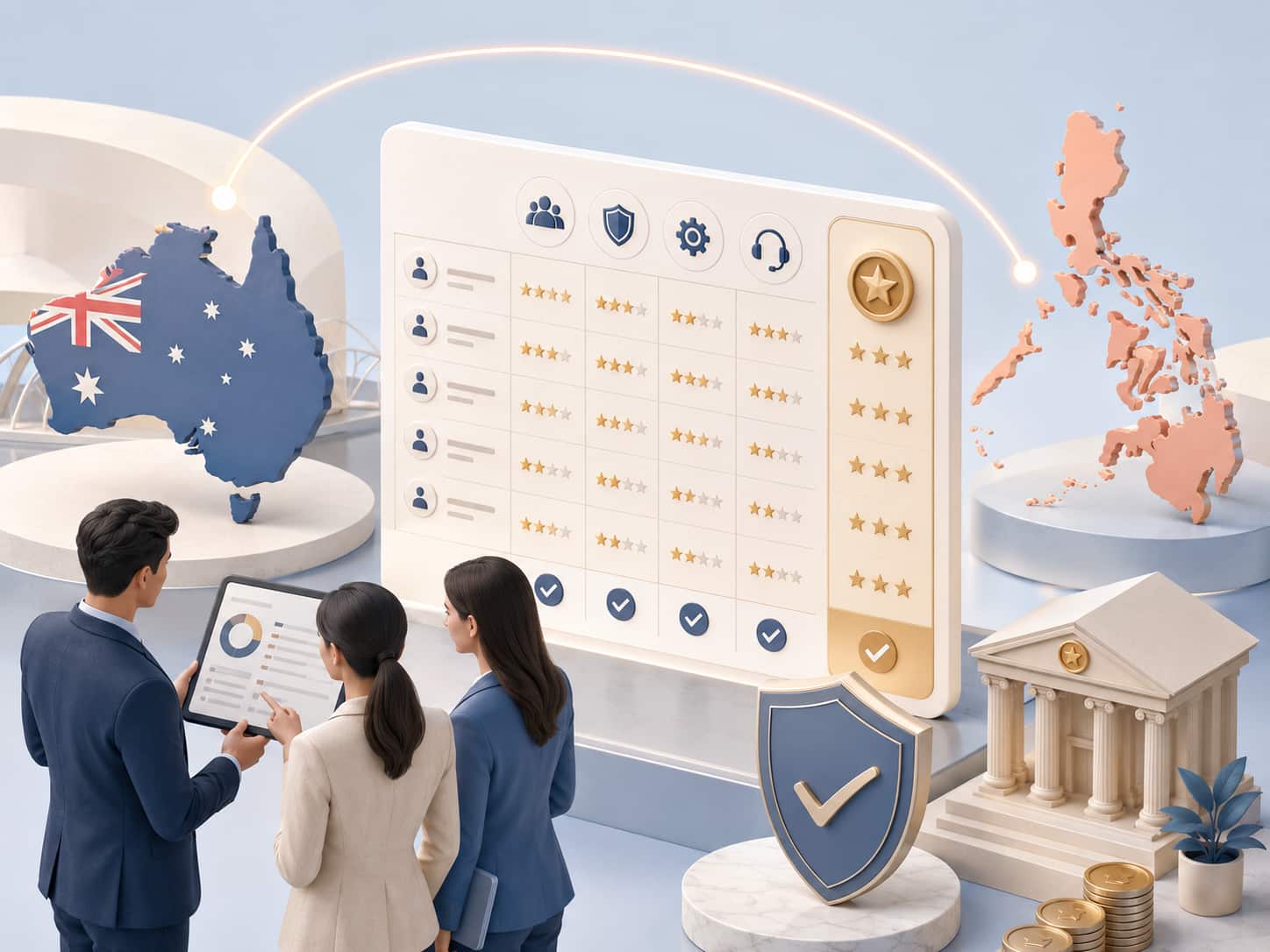
When reviewing an EOR, compare providers with the Australian Financial Services EOR Vendor Scorecard using the same evidence and approval process for every provider.
Training checklist for Philippines financial-services teams
Training should be role-specific, not generic.
| Training area | Why it matters |
| Advice boundaries | Prevents support staff from giving or implying advice |
| Privacy and APP 8 | Supports offshore data-handling controls |
| Cybersecurity | Reduces account, device, and access risks |
| Client communication | Keeps messages factual and administrative |
| Document handling | Protects sensitive records and identity documents |
| Breach escalation | Ensures errors are escalated quickly |
| Complaint escalation | Prevents offshore staff from mishandling client complaints |
| Role-specific SOPs | Supports consistent work quality |
| Tool and CRM usage | Reduces data-entry and record-keeping errors |
Training completion should be recorded, refreshed, and reviewed when roles change.
Common AFSL risks with offshore teams
Avoid these common risks:
- unclear role boundaries
- offshore staff giving advice-like responses
- unreviewed advice documents
- excessive client-data access
- weak privacy disclosure
- no access logs
- no formal training record
- no documented supervision model
- contractor roles functioning like employees
- BPO staff with limited visibility or high turnover
- no proof of payroll or employment structure
- no incident escalation pathway
- no evidence of file review
- poor offboarding controls
Most offshore-team failures are not caused by location alone. They are caused by unclear controls.
When should an AFSL firm avoid offshore support?
Offshore support may not be appropriate where the firm cannot control role boundaries, data access, supervision, or review.
Delay or avoid offshore team setup if:
- role scope is unclear
- the licensee has not approved offshore support
- client contracts prohibit offshore access
- data-security controls are weak
- work requires unsupervised advice or decision-making
- no Australian reviewer is available
- systems cannot restrict access
- complaint or breach escalation is unclear
- the firm cannot maintain evidence
Offshoring should follow governance readiness, not just hiring need.
30/60/90-day setup plan for AFSL-aligned Philippines teams
| Timeline | Focus | Key actions |
| Days 1–30 | Governance design | Define role scope, restricted tasks, data access, supervision, licensee requirements, and employment model |
| Days 31–60 | Hiring and setup | Recruit or onboard staff, issue EOR documents, configure systems, complete training, prepare SOPs |
| Days 61–90 | Stabilisation | Validate payroll, review work quality, check access logs, confirm file review process, update proof pack |
A small admin team may move faster. A data-sensitive advice-support team should not move faster than the control framework allows.
Why Smart Outsourcing Solution for AFSL-aligned Philippines teams?
Smart Outsourcing Solution is a Philippines-first EOR and offshore team partner for Australian companies that want local employment support without setting up a Philippine entity.
For Australian financial services firms, SOS can support:
- EOR employment setup
- role and team mapping
- payroll onboarding
- employment documents
- payslips
- SSS, PhilHealth, and Pag-IBIG handling
- BIR withholding support
- 13th month pay administration
- benefits coordination
- employee communication support
- local HR documentation
- post-onboarding checks
- dedicated local account management
SOS is especially useful for AFSL holders, authorised representatives, and Australian financial services firms that want dedicated Philippines support staff with clearer employment structure, payroll evidence, and employee continuity.
SOS does not replace the firm’s AFSL compliance, licensee oversight, privacy obligations, advice supervision, or client-governance framework. It supports the local employment and payroll side of the operating model.
Related resources
- Hire Paraplanners in the Philippines – 2026 Guide
- Hire Financial Planning Administration Staff in the Philippines
- Offshore Mortgage Processing Teams Philippines – 2026 Guide
- Compliance Checklist for Australian Financial Services Companies Hiring in the Philippines
FAQs
Can an AFSL holder use a Philippines team?
Yes, but the AFSL holder should clearly define role scope, supervision, data access, file review, training, and evidence. Offshore teams should support regulated workflows without weakening advice supervision or client protection.
Does a licensee need to approve offshore support?
It depends on the licensee, dealer group, internal compliance framework, data-access rules, and outsourcing policies. Firms should check approval requirements before assigning work or granting system access to offshore staff.
Can Philippines staff prepare advice documents?
They may support document preparation, data entry, formatting, and research under supervision. Final advice, recommendations, client suitability, and sign-off should remain with appropriately authorised Australian staff.
Can Philippines staff speak to clients?
They may handle administrative communications if scripts, restrictions, and escalation rules are clear. They should not provide advice, recommendations, complaint decisions, or product guidance unless the firm’s licensing and supervision framework permits it.
Does using an EOR solve AFSL compliance?
No. An EOR helps with local employment, payroll, payslips, statutory handling, and HR administration. AFSL compliance, advice supervision, privacy governance, and client outcomes remain the responsibility of the Australian firm and its licensee framework.
What should be in an offshore-team proof pack?
Include licensee approval records, role descriptions, restricted task lists, supervision matrix, training records, confidentiality agreements, data-access approvals, access logs, SOPs, file review records, payroll records, EOR documents, and incident escalation process.
Is a contractor model safe for AFSL support roles?
A contractor model may suit short-term specialist work, but it is riskier for full-time, supervised, data-sensitive, or integrated roles. For ongoing support teams, EOR employment is often clearer.
What are the biggest risks of offshore AFSL support teams?
The biggest risks are role creep, advice-like communication, weak supervision, excessive data access, poor privacy controls, missing training records, no review logs, and unclear breach escalation.
Do Australian privacy rules apply when client data is accessed in the Philippines?
Australian privacy obligations may apply where personal information is disclosed or accessed offshore. Firms should review APP 8, privacy notices, contracts, access controls, and security safeguards before offshore access begins.
Which Philippines roles are common for Australian financial services firms?
Common roles include client services officers, paraplanning support, mortgage processing support, advice administration, compliance administration, CRM support, reporting support, and finance operations support.
Final takeaway
AFSL holders can build effective Philippines teams, but the arrangement must be controlled, documented, and supervised.
The safest model is not simply “hire offshore staff”. It is to define which tasks are allowed, which tasks are restricted, who supervises the work, how client data is protected, how outputs are reviewed, how role creep is monitored, and what evidence is kept.
For long-term Australian financial services support roles, EOR can provide a clearer employment and payroll structure while the Australian firm retains control over AFSL compliance, advice boundaries, privacy, licensee requirements, and client outcomes.
Ready to build an AFSL-aligned Philippines team?
Building a Philippines support team for an Australian financial services business? Contact Smart Outsourcing Solution to review your role structure, EOR setup, payroll model, employee onboarding, and local employment support.