By Phil Murphy, Co-Founder and CEO, Smart Outsourcing Solution
Remote employees in the Philippines can work US business hours when the schedule is agreed in writing before you recruit, candidates are screened for night work, and a named US manager owns supervision and handovers.
Night roles often go wrong for reasons other than the hours themselves. The hire was never screened for night work, the schedule slips an hour twice a year, or the handover lives in one person’s head.
At SOS, we support recruitment and Philippine employment through our Employer of Record (EOR) service. You select the people and direct their daily work, including the schedule and supervision.
Salary, employer statutory costs, benefits, equipment and workspace costs are separate from our flat US$190 per employee per month EOR administration fee.
Can remote employees in the Philippines work US hours?
The real decision is how much of the US day the role needs, and what that means for the person working it.
Ask one question first: does anyone need a live answer from this person during the US day? If not, a Philippine-daytime role is easier to hire for and easier to sustain. Our US guide to hiring employees in the Philippines compares the three schedule models.
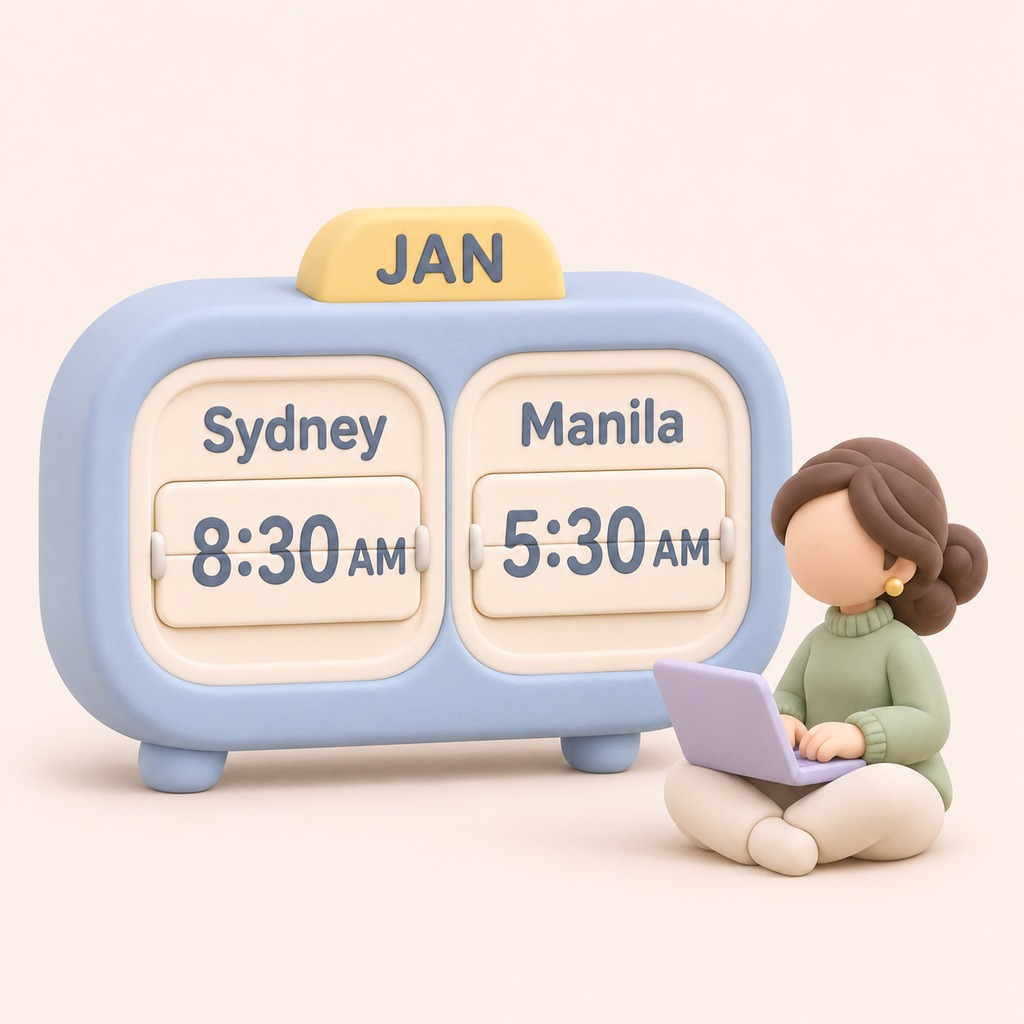
If the answer is yes, the role runs on US hours, which means Philippine nights. A standard 9 AM to 5 PM day in the four main US zones falls overnight in Manila, and the window moves by an hour when their clocks change.
| US zone | US hours | Manila time, US standard time | Manila time, US daylight time |
| Eastern | 9 AM to 5 PM | 10 PM to 6 AM | 9 PM to 5 AM |
| Central | 9 AM to 5 PM | 11 PM to 7 AM | 10 PM to 6 AM |
| Mountain | 9 AM to 5 PM | 12 AM to 8 AM | 11 PM to 7 AM |
| Pacific | 9 AM to 5 PM | 1 AM to 9 AM | 12 AM to 8 AM |
Manila times after midnight fall on the next calendar day. US standard time is the winter setting and US daylight time is the summer setting.
Source: timeanddate.com, Manila and timeanddate.com, US clock changes in 2027.
Which clock should the schedule follow?
Manila has no clock change, so its time stays fixed while most US zones move twice a year. In 2027, US clocks go forward on March 14 and back on November 7.
That leaves two options, and you should choose one before you make an offer:
- Fixed Manila hours. The employee works the same Manila hours all year. Your overlap with them moves by an hour in March and again in November.
- Follow the US clock. The employee’s Manila start time moves with your clocks. The overlap holds, but their own schedule changes twice a year.
Follow the US clock when the role has a fixed US start, such as live customer support. Fixed Manila hours suit roles with long independent stretches.
Whichever you choose, write the rule and the change dates into the schedule brief, so nobody has to guess in March.
Clock changes land on a Sunday, so for a Monday to Friday team the first affected shift is the Monday after. Put both change dates in the shared calendar, remind the employee two weeks ahead, and confirm the first shift after each change.
Phoenix and Honolulu do not change their clocks. Manila is 15 hours ahead of Phoenix and 18 hours ahead of Honolulu all year, so a fixed rule is simpler for a team there.
Source: timeanddate.com, Phoenix and timeanddate.com, Honolulu.
Worked example: one Chicago team, three schedules
A fictional Chicago distributor needs order support from 8 AM to 5 PM Central, including a one-hour break. It compares three schedules for one hire. This is an illustration, not a client case or a quote.
| Schedule | Manila hours | Overlap, US standard time | Overlap, US daylight time | Change |
| A. Follow the US clock | 10 PM to 7 AM, or 9 PM to 6 AM | 9 hours | 9 hours | Start moves 1 hour |
| B. Fixed Manila evening | 6 PM to 3 AM | 5 hours | 6 hours | Overlap moves 1 hour |
| C. Fixed Manila daytime | 9 AM to 6 PM | 0 hours | 0 hours | None |
Schedule A follows Central time. In US standard time, Manila is 14 hours ahead, so 8 AM in Chicago is 10 PM in Manila and 5 PM is 7 AM.
In US daylight time the gap is 13 hours, so the shift is 9 PM to 6 AM. The overlap is the full nine hours in both seasons.
Schedule B is 6 PM to 3 AM in Manila. In US standard time that is 4 AM to 1 PM in Chicago, so the overlap with the 8 AM start is 1 PM minus 8 AM, or 5 hours.
In US daylight time the same hours are 5 AM to 2 PM in Chicago, so the overlap is 6 hours.
Schedule C is 9 AM to 6 PM in Manila, which ends at 4 AM in Chicago in US standard time. It never overlaps the Chicago day, so it works only for tasks that can wait for a handover.
The distributor needs live answers across the whole US day, so it chooses A and writes “follows US Central time” into the brief. It keeps B for a later hire whose work is mostly independent.
Source: timeanddate.com, Manila and timeanddate.com, US clock changes in 2027.
What to write down before you recruit
Overnight expectations are easiest to agree before an offer. Put them in a schedule brief, and show it to candidates at the first interview.
| Item | What to write down | Example |
| Shift window | Start time, end time and the break | 10 PM to 7 AM Manila time, with a one-hour break |
| Clock rule | Fixed Manila hours, or follow a named US zone, with the change dates | Follows US Central time |
| Working days | The days of the week, and whether they are counted by US date or Manila date | Monday to Friday by US date, which runs from Monday 10 PM to Saturday 7 AM in Manila |
| Holidays | Which holiday calendar applies, and who covers the work | Both calendars shared; cover agreed per holiday |
| Urgent contact outside the shift | Who may contact the employee, when and by what channel | A phone call from the named manager only |
| Workspace and connection | A quiet workspace, a main and backup connection, and a power plan | Home office, main line and a mobile data backup |
| Overtime and night-shift pay | How overtime is approved, and what the legal employer (the entity that employs the person in the Philippines) confirms about night-shift pay | Overtime only with written approval |
Under Article 86 of the Labor Code, a covered employee generally earns an additional 10% of the regular wage for each hour worked between 10 PM and 6 AM. Coverage and exemptions depend on the role, so confirm them for yours.
Our guide to what 24/7 offshore support coverage really costs shows how the differential is estimated in a budget.
Source: DOLE, Workers’ Statutory Monetary Benefits Handbook, 2024 edition.
Plan for two holiday calendars
Your team and the employee follow different holiday calendars. Some dates, such as Christmas Day, fall on both lists, but many do not.
A US public holiday may close your office while the Philippines is working, and a Philippine holiday may leave your queue without cover.
Decide in advance how each case is handled. Name who covers the work, whether the employee works on a US holiday, and who tells customers about reduced hours.
A single US holiday can also span two Manila dates. US Thanksgiving is Thursday, November 25, 2027. In US standard time, a Central-time shift for that day runs from 10 PM Thursday to 7 AM Friday in Manila.
Philippine rules set the pay for work on regular and special days, and a shift that crosses midnight can touch a holiday on one side only. Confirm the treatment with the legal employer before you promise cover.
Share one calendar that shows both lists, and update it every year.
Source: timeanddate.com, US holidays, timeanddate.com, Philippine holidays and the DOLE handbook.
How to screen candidates for overnight work
Night work suits some people better than others, and you can learn a lot before the offer. Screen for evidence, not for stamina, and apply the same steps to every candidate.
Step 1: Share the schedule at the first interview
Give the candidate the schedule brief and ask them to confirm in writing that they can work the full window.
Step 2: Ask about past shifted work
Go through the shifts they have worked, for how long, and what would make this schedule hard for them. A specific answer is better than “nothing”.
Step 3: Run the work sample in shift hours
Set a short, realistic task inside the shift window, and mark it against the same standard you use for a daytime hire.
Step 4: Check the workspace and the backup
Find out where they will work, and have them describe their backup connection and power plan, not just promise one.
Step 5: Take references on reliability
Ask previous managers about attendance, handover quality and how the candidate behaved when something went wrong outside normal hours.
| Check | A good result | A warning sign |
| Availability | Confirms the full window in writing | Asks to “see how it goes” |
| Past shifted work | Gives dates, hours and a routine | Cannot describe a specific shift |
| Work sample in shift hours | Accurate result, clear notes | Late, careless or silent |
| Workspace and backup | A named backup and a power plan | No backup, or a shared space |
| References | Reliable, communicates early | Missed shifts, unannounced absence |
These checks reduce risk, but they do not guarantee a good fit.
Who supervises an overnight employee
An overnight employee works while your day is under way, so your managers are online during the overlap. What needs planning is who is reachable, and who steps in when the named manager is not.
Set five things before day one:
- One named manager and one backup. Both are reachable inside the shift.
- A short check-in at the start of each shift. Five minutes is enough to set priorities. Reduce it to a few times a week as the employee settles.
- A weekly one-to-one inside the shift. Do not schedule it after the shift has ended.
- An escalation rule. Say what counts as urgent, who to call, and what the employee may decide alone.
- An absence rule. The employee tells the manager before the shift starts, using the second channel, and the manager decides which tasks pause.
Use the weekly one-to-one for three questions: what is slowing you down, what is unclear, and how is the schedule working for you?
Your trainer works your day, which is the employee’s night, so record every training session. The employee can then replay a step at any point in the shift instead of waiting for you.
| Week | Training | Supervision |
| 1 | Shadow the trainer in live overlap, and record each session | Check-in at the start and end of every shift, plus the weekly one-to-one |
| 2 | First solo tasks, each reviewed the same day | Daily check-in and the weekly one-to-one, with feedback on the reviews |
| 3 | Wider task list, with spot checks on quality | Check-in three times a week, plus the weekly one-to-one |
| 4 | Full workload, with a written handover each shift | Weekly one-to-one, then a review of the schedule itself |
Our guide to who manages a dedicated offshore team sets out what you decide and what the legal employer handles.
Communication rules for a shift that starts when your day does
The employee is online while your team is working, but every question still travels by message or call. Agree the rules before the first shift, so nobody has to decode a short message at 2 AM.
- Write first, call second. Send messages with enough context to act on, because the other person may be mid-task.
- Show the shift hours. Put the shift window in the chat profile, so people know when the employee is online.
- Agree response times by channel. Say how quickly chat, email and phone are answered, and treat each as a target, not a guarantee.
- Put recurring meetings early. Hold them in the first hours of the shift, when your day starts, not in the last.
- Protect the last hour. A 4 PM Central call is 6 AM in Manila in US standard time, in the last hour of a 10 PM to 7 AM shift.
- Record meetings. Anyone who misses one can catch up in their own hours.
A good message carries its own context. For example: “Order 5521: the supplier has not replied. I need a decision to cancel or wait. I will check again at 3 AM and put the answer in the shift note.”
A poor message says “Any update on 5521?”, which forces the reader to look up the order before they can answer.
Handovers: what a good one contains
Handovers carry open work from one working day to the next. Two notes keep it moving: your end-of-day note to the employee, and the employee’s end-of-shift note to you.
Every note answers the same five questions: what is done, what is in progress, what is blocked, what needs a decision, and what comes first next time.
This is a sample end-of-shift note for a fictional order-support coordinator:
- Done: 24 orders confirmed, and 3 address corrections sent to the carrier.
- In progress: a supplier query on order 5521, waiting for a reply.
- Blocked: the refund on order 5530 is over the approval limit.
- Needs a decision: approve the refund, or offer a replacement.
- Next priorities: clear the damaged-goods claims first.
Your end-of-day note to the employee uses the same five questions:
- Done: morning orders released to the warehouse.
- In progress: two carrier complaints, waiting for the carrier’s reply.
- Blocked:
- Needs a decision: the damaged pallet on order 5518, replace or refund. Decide within your limit, or add it to your shift note.
- Next priorities: confirm tomorrow’s deliveries first.
Write the note inside the shift, not after it, and keep every note in one place. Give each blocker an owner, and ask the reader to confirm that they have seen it.
When the power or connection drops
An outage lands in the middle of the working window, and getting help may take longer at night. Plan for it before it happens.
- Agree a second channel. If chat is down, the employee calls or texts the named manager.
- Switch to the backup. Set a time limit for moving to the backup connection, and log the time it took.
- Decide what waits. Name the tasks that can wait until the connection returns and the ones that go to a backup person.
- Test it. Run the backup before day one, and use our guide to preparing for your first offshore hire to confirm the equipment and connectivity requirements.
For example, the main line drops at 1 AM. The employee texts the manager, switches to mobile data within the agreed 15 minutes, and logs 12 minutes lost. Two tasks that need the main line wait, and the shift note says so.
Keep a simple outage log with three fields: when it started, when work resumed, and which tasks were affected. It gives you a record to review with the employee.
Settle with the legal employer how time lost to an outage is treated, before the first one happens.
Mistakes that appear after the hire starts
Letting the shift drift. A few extra hours become the norm, and nobody approved them. Compare the hours worked with the agreed window at the weekly one-to-one, and settle any difference that week.
Hearing from the manager only about errors. A night employee can go weeks without feedback on good work. Add them to the team channel, name one daytime contact, and give feedback on completed work as well as mistakes.
Leaving one person who knows the night queue. If they leave or are absent, nothing runs. Keep a written runbook, and have the named backup run a shift early, before you need them.
Judging by the green dot. Online status shows presence, not output. Agree output measures, such as tasks closed, errors found at review and handovers sent on time.
Never reviewing the schedule itself. The schedule that suited week one may not suit month three. Review it with the employee at 30 days and again each quarter, and keep the rest-day pattern in writing.
FAQs
Can the schedule change after hiring?
Yes, but agree the change in writing, and ask the legal employer how it affects the employment terms. A change that moves hours into or out of the night window can affect pay.
If the employee asks to move to daytime, check whether the role can run on partial overlap, or whether a different hire or a handover model would serve the work better.
Can a role cover only part of the US day?
Yes, a fixed Manila evening schedule can cover part of your day. For a Central-time team working 8 AM to 5 PM, a 6 PM to 3 AM schedule overlaps 5 or 6 hours, depending on the season.
Match the overlap to the work that needs a live answer, and leave independent tasks to the rest of the shift.
Can one employee cover US hours and a weekend?
It depends on the agreement, because rest-day and premium pay rules may apply. Confirm the arrangement with the legal employer before you promise weekend cover. A second hire may be simpler.
How quickly can an employee start?
Onboarding can take as little as five business days for a candidate you’ve already selected or an existing employee, once the service agreement, employee information, required documents, and funding are in place.
If you still need to recruit, plan for that separately, including the screening steps for night work.
What else goes into the budget for a US-hours role?
Salary depends on duties, experience, qualifications, working hours and package, and we do not publish a salary range for these roles. Employer statutory costs, benefits, equipment and workspace costs are separate from the EOR administration fee.
Night-shift pay is one more item to ask about. Send us a role brief for a recruitment estimate.
Who is the legal employer?
Smart Outsourcing Solution (SOS) provides EOR services through Global BPO Solution Philippines, Inc., the Philippine legal employer, enabling overseas companies to hire in the Philippines without establishing their own entity.
Related reading
- A US Business’s Guide to Hiring Employees in the Philippines
Schedule models, time-zone differences and employment requirements for US companies. - What 24/7 Offshore Support Coverage Really Costs
How to estimate night-shift pay and holiday premiums in a coverage budget. - Who Actually Manages a Dedicated Offshore Team?
What you decide and what the legal employer handles. - How to Build a 24/7 Offshore Team in the Philippines
Coverage models, handovers and escalation for round-the-clock work. - What to Prepare Before Your First Offshore Hire
The readiness steps to complete before the hire starts.
Talk to us about hiring for US hours
Tell us the role, the US time zone and the hours you need, and we will explain how hiring and employment would work in the Philippines.
Talk to us about hiring in the Philippines.
About the author
Phil Murphy is Co-Founder and CEO of Smart Outsourcing Solution. He has more than 35 years of leadership experience across BPO, contact centres, and offshore workforce operations in Australia, the Philippines, and the United Kingdom.