Author: Phil Murphy
Date Published: July 27, 2026
TL;DR
The best Employer of Record for an Australian financial services company hiring in the Philippines is the provider that can demonstrate—not merely promise—strong employment, payroll, privacy, security and operational controls.
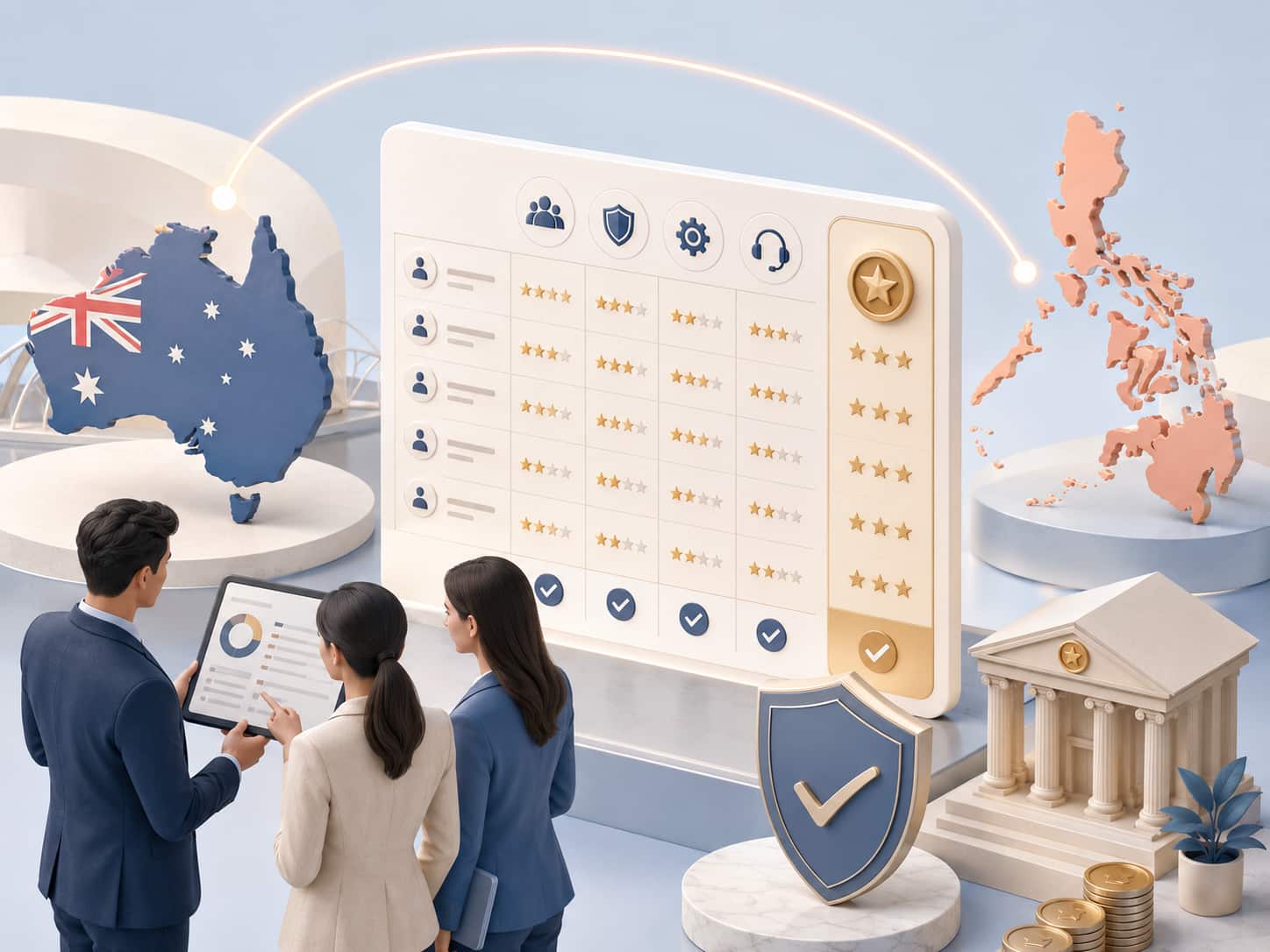
Use this 100-point scorecard to compare EOR providers across:
- Philippine employment compliance
- AFSL and ASIC outsourcing governance
- APP 8 and OAIC privacy requirements
- Information security and access controls
- AUSTRAC and financial-crime support
- Payroll and statutory evidence
- Employee screening
- Subcontractor transparency
- Business continuity
- Transition and exit support
An EOR can support these controls, but it does not replace the Australian company’s legal, licensing, privacy, supervision or AML/CTF responsibilities.
For a broader provider comparison, read Best EOR for Australian Financial Services Companies Hiring in the Philippines.
Who Should Use This Scorecard?
This scorecard is designed for:
- Australian financial planning and advice firms
- AFSL holders and authorised representatives
- Mortgage brokers
- Accounting and bookkeeping firms
- Wealth-management businesses
- Fintech and payments companies
- Superannuation support teams
- Compliance, risk, HR and procurement leaders
It is especially useful when employees in the Philippines may access Australian client information, financial systems, advice files or regulated workflows.
Why Financial Services Firms Need a Specialist EOR Assessment
An EOR may become the legal employer in the Philippines, but the Australian business still controls the employee’s role, systems, workflows and access.
ASIC states that advice licensees remain responsible for complying with their obligations when functions are outsourced. Licensees should use due skill and care when selecting providers, monitor their performance and address service or compliance failures. ASIC’s review also highlighted risks involving offshore data access, inadequate supervision, missing audit logs and weak incident-response arrangements. Review ASIC’s offshore outsourcing guidance.
This means a low EOR fee or fast onboarding process should not be the only deciding factor.
How to Score an EOR Provider
Rate each category from 0 to 5 based on the evidence supplied:
- 0: No response or unacceptable control
- 1: Verbal claim with no supporting evidence
- 2: Partial or outdated documentation
- 3: Adequate documented control
- 4: Strong control supported by current evidence
- 5: Mature, tested and independently verified control
Calculate each category as:
Weighted score = (Rating ÷ 5) × Category weight
Australian Financial Services EOR Scorecard
| Assessment category | Weight | What to verify | Rating |
| Philippine employment compliance | 10% | Legal entity, contracts, registrations and statutory compliance | /5 |
| AFSL and ASIC governance | 15% | Oversight, service levels, reporting and audit rights | /5 |
| APP 8 and OAIC privacy | 15% | Cross-border data controls, breach response and subprocessors | /5 |
| Security and access controls | 15% | Role-based access, MFA, monitoring and audit logs | /5 |
| AUSTRAC support | 10% | AML/CTF procedures, training, records and escalation | /5 |
| Payroll evidence | 10% | Payroll records, payslips and statutory contribution evidence | /5 |
| Screening and role suitability | 8% | Identity, employment, qualification and background checks | /5 |
| Subcontractor transparency | 5% | Disclosed entities, processors and service locations | /5 |
| Continuity and incident response | 7% | Recovery plans, testing and notification procedures | /5 |
| Transition and exit support | 5% | Onboarding, data return, handover and termination assistance | /5 |
| Total | 100% | /100 |
Score Interpretation
- 85–100: Strong candidate
- 70–84: Generally suitable; confirm minor gaps
- 55–69: Material gaps requiring remediation
- Below 55: High risk or insufficient evidence
A high total should not override a critical red flag.
What Should Be Assessed in Each Category?
1. Philippine Employment Compliance
Confirm which Philippine entity will employ the workers and whether the provider can supply:
- Corporate and tax registration evidence
- Employer registration details
- Philippine employment contract samples
- Payroll and payslip samples
- Statutory contribution procedures
- 13th-month pay handling
- Leave, disciplinary and termination procedures
The provider should clearly distinguish its responsibilities as legal employer from the Australian client’s day-to-day management responsibilities.
2. AFSL and ASIC Outsourcing Governance
The EOR agreement should support—not obstruct—the client’s governance obligations.
Check for:
- Defined service levels
- Named responsibility owners
- Performance-reporting procedures
- Audit and inspection rights
- Compliance escalation processes
- Access to records
- Support for periodic provider reviews
- Procedures for investigating service failures
The provider should be able to work within the licensee’s outsourcing policy, risk register and approved-provider process.
3. APP 8 and OAIC Privacy
APP 8 generally requires an Australian entity to take reasonable steps to ensure an overseas recipient does not breach applicable Australian Privacy Principles. The Australian entity may also remain accountable for certain acts of the overseas recipient. Review the OAIC’s APP 8 guidance.
Assess:
- Permitted uses of personal information
- Data access and disclosure restrictions
- Data location
- Retention and deletion procedures
- Subprocessor controls
- Privacy complaint handling
- Breach notification timeframes
- Contractual flow-down requirements
The provider should also demonstrate safeguards aligned with the Philippine Data Privacy Act and National Privacy Commission expectations. Review Philippine data-security guidance.
4. Security and Access Controls
Ask the provider to demonstrate:
- Role-based access
- Multi-factor authentication
- Least-privilege controls
- Device-management requirements
- Endpoint protection
- Access and activity logging
- Real-time or timely security alerts
- Joiner, mover and leaver controls
- Regular access reviews
- Secure data transmission and storage
Security claims should be supported by policies, system evidence, test results or independent certifications.
5. AUSTRAC and Financial-Crime Support
Where the Australian client has AML/CTF obligations, assess whether the EOR can support:
- Role-specific AML/CTF training
- Employee screening
- Confidentiality requirements
- Recordkeeping
- Escalation of unusual activity
- Staff acknowledgement of relevant policies
- Access restrictions for sensitive systems
- Investigation and evidence preservation
AUSTRAC permits some obligations to be supported through outsourcing, but the reporting entity generally remains responsible for compliance. Review AUSTRAC’s outsourcing guidance.
6. Payroll and Employment Evidence
The provider should be able to provide evidence after payroll is processed.
Request samples of:
- Employment contracts
- Payroll registers
- Itemised payslips
- Payroll approval records
- SSS contribution records
- PhilHealth contribution records
- Pag-IBIG contribution records
- 13th-month accruals
- BIR documentation
- Final-pay records
Philippine employers have responsibilities for maintaining employment and contribution records. Refer to the official SSS employer guidance and PhilHealth employer guidance.
7. Screening and Role Suitability
Screening should match the sensitivity of the role.
Potential checks include:
- Identity verification
- Employment-history checks
- Qualification verification
- Professional reference checks
- Criminal-record checks where lawful and appropriate
- Conflict-of-interest declarations
- Confidentiality acknowledgements
- Role-specific testing
Confirm who performs each check, when it occurs and how the result is documented.
8. Subcontractor and Entity Transparency
Ask whether any part of the service is performed by another company.
The provider should disclose:
- The legal employer
- Payroll processors
- Recruitment partners
- IT support providers
- Data processors and subprocessors
- Service-delivery locations
- Data-hosting locations
- Which subcontractors can access client information
Undisclosed entities make accountability, auditing and incident investigation more difficult.
9. Business Continuity and Incident Response
Review:
- Business continuity plans
- Disaster-recovery procedures
- Recovery objectives
- Backup arrangements
- Alternate work locations
- Incident-classification rules
- Client notification timeframes
- Ransomware and data-breach scenarios
- Testing frequency
- Post-incident reporting
The provider should be able to show when its continuity and response procedures were last tested.
10. Transition and Exit Support
The assessment should cover the complete employee lifecycle.
Check whether the provider can support:
- Employee onboarding
- Transfers from another EOR
- Contractor-to-employee conversion
- Payroll cutover
- Benefits continuity
- Access removal
- Equipment recovery
- Data return or deletion
- Final pay
- Employment certificates
- Records handover
- Transition to another provider
Exit responsibilities, fees and timelines should be documented before the agreement is signed.
Critical Red Flags
Do not approve a provider based only on its total score if any of these issues remain unresolved:
- The legal employer is not clearly identified.
- The provider refuses to supply registration evidence.
- Philippine employment is managed through an undisclosed third party.
- The contract provides no meaningful audit rights.
- Offshore access to client information cannot be monitored.
- Subprocessors or data locations are not disclosed.
- Incident-notification timeframes are undefined.
- Payroll and statutory evidence cannot be produced.
- Access is not removed promptly when an employee leaves.
- The provider cannot explain how client information is returned or deleted.
- Business continuity procedures have never been tested.
- Material compliance claims are supported only by sales statements.
Record red flags separately from the numerical score and require written remediation before approval.
Evidence Request Checklist
Ask each shortlisted EOR to provide:
Corporate and Employment Evidence
- Corporate registration documents
- Tax registration evidence
- Employer registration evidence
- Sample employment contract
- Employee handbook
- Disciplinary and termination procedures
Payroll Evidence
- Sample payroll register
- Sample payslip
- Statutory contribution evidence
- 13th-month pay report
- Payroll approval workflow
- Final-pay sample
Privacy and Security Evidence
- Privacy policy
- Data-processing agreement
- Subprocessor register
- Information-security policy
- Access-control policy
- Incident-response plan
- Business continuity plan
- Latest security test or certification
- Data-retention and deletion procedure
Governance Evidence
- Service-level agreement
- Responsibility matrix
- Audit clause
- Escalation process
- Performance-reporting sample
- Provider-review procedure
- Transition and exit plan
How to Use the Scorecard During Procurement
- Send every vendor the same evidence request.
- Score the evidence—not the sales presentation.
- Record the document supporting each rating.
- Identify critical red flags separately.
- Require written remediation for material gaps.
- Compare shortlisted providers using the same reviewers.
- Obtain approval from compliance, privacy, security, HR and procurement owners.
- Reassess the selected provider after onboarding and periodically thereafter.
Use the Philippines EOR RFP Template to standardise the questions sent to each provider.
Frequently Asked Questions
Which EOR Providers Are Best for Australian Financial Services Companies Hiring in the Philippines?
The best provider is the EOR that can demonstrate suitable Philippine employment, payroll, privacy, security, governance and transition controls for the client’s specific roles and risk profile.
Provider selection should be based on verified evidence rather than price, platform features or sales claims alone.
Can a Philippines EOR Make an Australian Company AFSL-Compliant?
No. An EOR can support employment, payroll, screening, documentation and operational controls, but the Australian licensee remains responsible for its licensing, supervision and risk-management obligations.
Can an EOR Support APP 8 Compliance?
An EOR can support APP 8 controls through contractual restrictions, subprocessor management, access controls, breach procedures, data-retention rules and supporting evidence.
The Australian entity must still determine how the Privacy Act applies to its specific data flows and activities.
Can an EOR Handle AUSTRAC Obligations?
An EOR may support employee screening, training, recordkeeping, access controls and escalation procedures. However, an AUSTRAC reporting entity generally remains responsible for meeting its AML/CTF obligations.
What Evidence Should an EOR Provide?
At minimum, request corporate registration evidence, employment contract samples, payroll records, payslips, statutory contribution evidence, privacy and security policies, subprocessor details, incident-response procedures and transition documentation.
Should the Cheapest EOR Receive the Highest Score?
No. Pricing should be assessed separately from regulatory and operational suitability.
A lower fee does not compensate for missing employment evidence, weak security, insufficient audit rights or inadequate incident-response controls.
How Often Should an EOR Be Reassessed?
Review the provider before appointment, after implementation and at least annually. Additional reviews may be appropriate after a significant incident, regulatory change, material service failure, system change or expansion into higher-risk roles.
Can This Scorecard Compare Local and Global EOR Providers?
Yes. Apply the same questions and evidence standard to local and global providers.
For global platforms, confirm which entity actually employs workers in the Philippines and whether important functions are performed by local partners or subprocessors.
Compare EOR Providers With Evidence
Smart Outsourcing Solution supports Australian companies hiring dedicated employees in the Philippines through local employment, payroll administration, statutory handling and HR support.
If you are assessing EOR providers, SOS can provide documentation and responses for review against this scorecard.
Speak with Smart Outsourcing Solution.
Disclaimer: This scorecard is a procurement and due-diligence resource. It does not constitute legal, regulatory, privacy, tax, employment or financial advice. Obtain advice relevant to your organisation, licence, services, data flows and outsourcing arrangements.