Can an Employer of Record Sponsor Work Visas in the Philippines? (AEP / 9(g) Permit Guide for 2026)
Author: Martin English, CEO & Founding Partner
Updated: May 28, 2026
TL;DR
An Employer of Record may be able to support work visa and permit processes in the Philippines only if the EOR is the lawful local employer or qualifying Philippine sponsor for the worker and the case meets government requirements.
For most foreign nationals working in the Philippines, the two core items to understand are:
| Item | What It Is | Government Body |
| Alien Employment Permit | A work authorization issued to a foreign national who will engage in gainful employment in the Philippines | DOLE |
| 9(g) Pre-arranged Employment Visa | A work visa route for foreign nationals with pre-arranged employment in the Philippines | Bureau of Immigration |
The key point: an EOR cannot simply “attach” a visa to any foreign worker unless the employment structure, sponsor, job role, documents, and government requirements are valid.
A compliant Philippines EOR should also provide employment and payroll proof, including:
- DOLE-aligned employment contract
- Payroll records
- Payslips
- SSS, PhilHealth, and Pag-IBIG handling where applicable
- 13th-month pay records where applicable
- Remittance evidence or summaries
- Final pay and offboarding records
For the broader compliance standard, read Philippines EOR Compliance.
Can an Employer of Record Sponsor a Work Visa in the Philippines?
An EOR may support work visa sponsorship in the Philippines when it is properly acting as the local employer or sponsor and the worker qualifies under the relevant permit and visa rules.
The answer depends on:
| Question | Why It Matters |
| Is the worker a foreign national? | Filipino citizens do not need AEP or 9(g) visas to work in the Philippines |
| Will the person work physically in the Philippines? | Work visa issues usually arise when a foreign national is working in-country |
| Who is the legal employer? | The sponsor must match the actual employment structure |
| Does the role qualify? | The role must satisfy the relevant work authorization requirements |
| Is there a valid employment contract? | Work authorization usually depends on documented employment |
| Can the employer provide required company documents? | AEP and visa processes require employer-side documentation |
| Are payroll and statutory records handled properly? | Visa-linked employment should align with payroll compliance |
DOLE’s AEP guidance covers foreign nationals intending to engage in gainful employment in the Philippines, while Bureau of Immigration guidance covers the 9(g) Pre-arranged Employment Visa process.
What Is an Alien Employment Permit?
An Alien Employment Permit, or AEP, is a permit issued through DOLE that allows a foreign national to work in the Philippines.
AEP is not the same as a visa. It is work authorization. The 9(g) visa is an immigration status route handled through the Bureau of Immigration.
| Item | AEP |
| Purpose | Work authorization for foreign nationals |
| Issuing body | DOLE |
| Applies to | Foreign nationals engaging in gainful employment in the Philippines |
| Usually connected to | Local employment, job role, and employer documentation |
| Not the same as | 9(g) visa or immigration status |
DOLE’s published AEP materials include application forms, checklists, establishment reporting, and related documents for alien employment permit processing.
What Is a 9(g) Pre-arranged Employment Visa?
A 9(g) Pre-arranged Employment Visa is a Philippine work visa route for foreign nationals who have pre-arranged employment in the Philippines.
| Item | 9(g) Visa |
| Purpose | Work visa / immigration status for pre-arranged employment |
| Government body | Bureau of Immigration |
| Applies to | Foreign nationals employed in the Philippines under a qualifying arrangement |
| Usually requires | Employer or sponsor filing, documentary requirements, BI process, and ACR I-Card steps |
| Works with | AEP or other applicable work authorization pathway, depending on the case |
The Bureau of Immigration lists the 9(g) Pre-arranged Employment Visa process and related steps such as official receipt submission, hearing, image and fingerprint capture, visa approval checking, passport submission for implementation, and ACR I-Card claiming.
AEP vs 9(g): What Is the Difference?
| Question | AEP | 9(g) Visa |
| What is it? | Work authorization | Work visa / immigration status |
| Who handles it? | DOLE | Bureau of Immigration |
| What does it prove? | The foreign national is permitted to work in a covered job | The foreign national has immigration status for pre-arranged employment |
| Is it a visa? | No | Yes |
| Is it employer-linked? | Usually yes | Usually yes |
| Can an EOR support it? | Potentially, if it is the valid employer / sponsor and requirements are met | Potentially, if it is the valid employer / sponsor and requirements are met |
AEP and 9(g) should not be treated as interchangeable. A compliant provider should explain both clearly.
When Can an EOR Support AEP / 9(g) Processing?
An EOR may be able to support the process when:
| Requirement | Why It Matters |
| The EOR is the local legal employer or valid sponsor | The sponsor must match the employment structure |
| The worker has a qualifying role | The role must fit work authorization requirements |
| The worker will be physically working in the Philippines | Work visa issues usually arise for foreign nationals working in-country |
| Employment documents are locally aligned | The contract should support the permit / visa application |
| Company documents are available | Government applications require employer-side evidence |
| Payroll can be run locally | Visa-linked employment should match payroll records |
| Compliance evidence can be produced | Payslips, payroll records, statutory records, and remittance proof may be needed |
If the EOR is not the actual legal employer or cannot act as a lawful sponsor, it should not claim that it can sponsor the visa.
When an EOR May Not Be the Right Visa Route
An EOR may not be the right route when:
| Situation | Why It May Be a Problem |
| The worker is not employed by the EOR | Sponsor and employment structure may not match |
| The worker is employed by another Philippine company | That employer may need to handle sponsorship |
| The foreign national is only visiting for meetings | A work visa may not be the correct category, depending on activity |
| The role does not qualify | AEP / 9(g) requirements may not be met |
| The company wants the worker under its own Philippine entity | Entity-sponsored employment may be better |
| The case involves immigration complexity | Specialist immigration counsel should review |
For complex foreign national cases, the page should not promise approval. It should state that eligibility depends on DOLE, BI, and case-specific review.
What Documents Are Typically Needed?
The exact checklist should always be verified against current DOLE and Bureau of Immigration requirements before filing.
Common document categories may include:
| Document Category | Examples |
| Worker documents | Passport, current visa / status, photos, forms, personal information |
| Employer documents | Company registration, business permits, employer request letters, establishment reports |
| Employment documents | Employment contract, job description, compensation details, role justification |
| AEP documents | DOLE application forms, checklist items, publication / labor market requirements where applicable |
| 9(g) documents | BI petition forms, supporting employer documents, AEP or work authorization evidence where applicable |
| ACR I-Card documents | BI-related identity and registration requirements |
| Payroll documents | Salary records, payroll setup, payslip process, statutory handling |
Philippine consular guidance states that the employer or sponsor in the Philippines should file the 9(g) petition with the Bureau of Immigration.
What Compliance Proof Should a Philippines EOR Provide?
If the EOR is employing a foreign national in the Philippines, it should provide the same employment proof expected for compliant local employment, plus visa-related records where applicable.
| Compliance Proof | Why It Matters |
| DOLE-aligned employment contract | Shows a proper local employment relationship |
| AEP records where applicable | Supports work authorization evidence |
| 9(g) visa records where applicable | Supports immigration status evidence |
| Payroll records | Shows salary, deductions, and pay treatment |
| Payslips | Gives employee-facing payroll transparency |
| SSS evidence where applicable | Shows social security handling |
| PhilHealth evidence where applicable | Shows health insurance contribution handling |
| Pag-IBIG evidence where applicable | Shows housing fund contribution handling |
| 13th-month pay records where applicable | Shows mandatory pay handling |
| Remittance evidence or summaries | Supports audit and due diligence |
| Final pay and offboarding record | Supports compliant exit handling |
For the full proof standard, link to Philippines EOR Compliance.
How Payroll Compliance Works for Foreign Employees in the Philippines
Payroll compliance should align with the employment arrangement.
A compliant EOR payroll process should document:
| Payroll Item | What Should Be Clear |
| Gross salary | Agreed monthly compensation |
| Payroll period | Covered dates and pay date |
| Allowances | Housing, transport, relocation, or other agreed benefits |
| Deductions | Statutory and approved deductions |
| Employer contributions | Employer-side obligations where applicable |
| Net pay | Employee take-home pay |
| Payslip | Employee-facing payroll record |
| Payroll register | Client-facing payroll record |
| Statutory evidence | SSS, PhilHealth, Pag-IBIG summaries where applicable |
| 13th-month pay | Accrual and payment treatment |
| Visa-linked employment record | AEP / 9(g) documents where applicable |
The payroll setup should not contradict the visa or employment documentation.
What Statutory Benefits Do Philippines Employees Need?
For employees in the Philippines, a provider should account for required payroll and statutory items.
| Item | Why It Matters |
| SSS | Social security contribution administration |
| PhilHealth | Health insurance contribution administration |
| Pag-IBIG | Housing fund contribution administration |
| 13th-month pay | Mandatory annual pay for covered employees |
| Payslips | Payroll transparency |
| Payroll records | Finance, audit, and employee support |
| Leave and HR records | Employment administration |
| Final pay | Clean offboarding |
Whether and how each item applies to a foreign national can depend on the worker’s status, employment arrangement, and current rules. The EOR should verify applicability before payroll setup.
AEP / 9(g) Timeline: What to Expect
Do not promise a fixed timeline. Government processing depends on case facts, documents, publication requirements, appointment availability, BI/DOLE processing, and whether the application has issues.
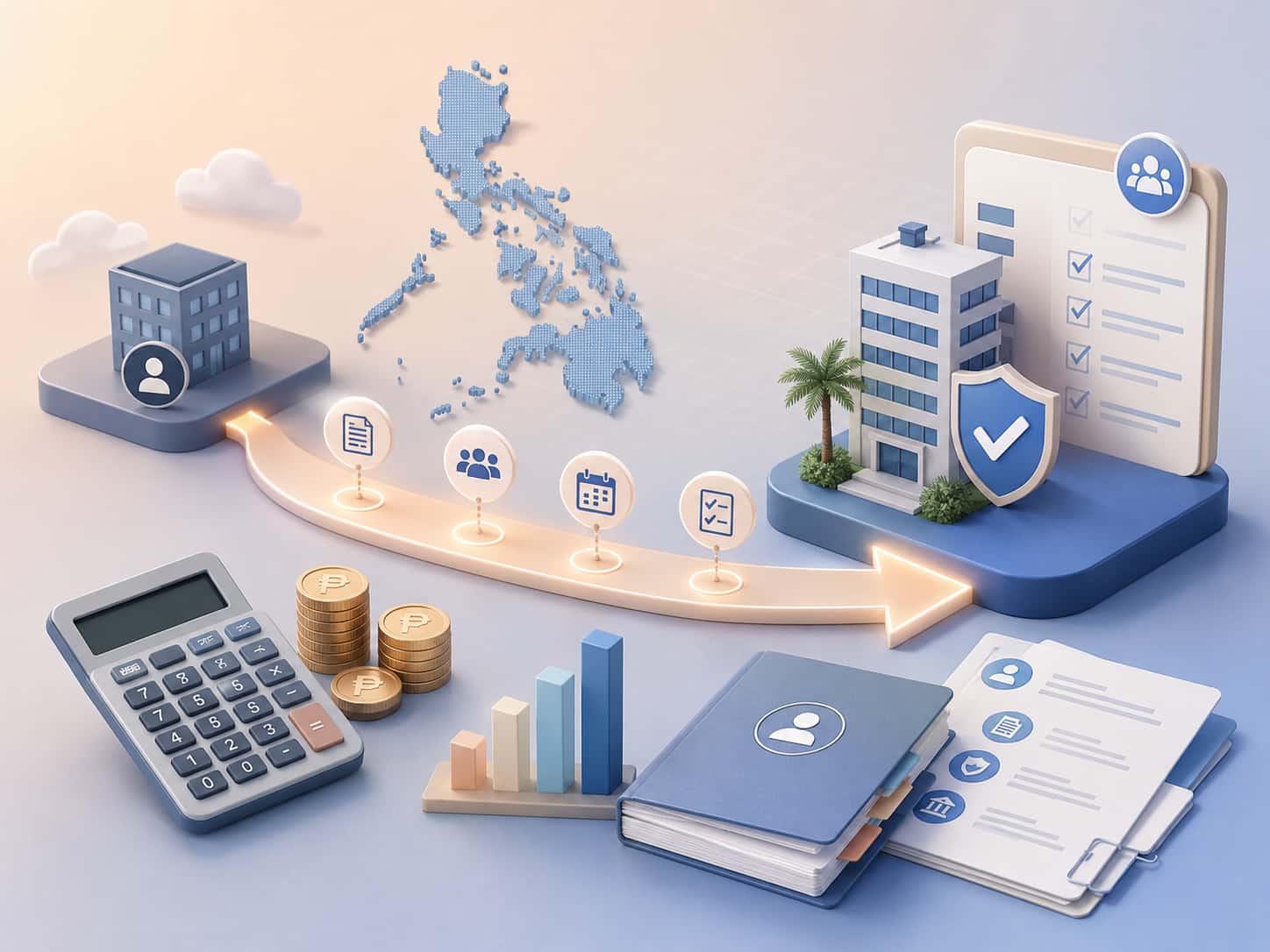
A practical process usually involves:
| Phase | What Happens |
| 1. Eligibility review | Confirm role, worker status, employer/sponsor structure, and required route |
| 2. Document collection | Gather worker, employer, job, and contract documents |
| 3. AEP process | Prepare and file AEP requirements where applicable |
| 4. BI petition | File or support 9(g) petition where applicable |
| 5. BI steps | Attend required hearing, biometrics, ACR I-Card steps, passport implementation |
| 6. Payroll alignment | Confirm salary, benefits, payroll records, and employment documentation |
| 7. Compliance file | Store AEP, 9(g), payroll, payslips, remittance evidence, and employment records |
The Bureau of Immigration’s 9(g) guidance includes steps such as attending a hearing, image and fingerprint capture, checking approval, passport submission for visa implementation, and ACR I-Card claiming.
EOR vs Own Entity for Work Visa Sponsorship
| Factor | EOR Route | Own Philippine Entity Route |
| Legal employer | EOR provider | Your Philippine entity |
| Local entity needed from client | No | Yes |
| Who may sponsor / petition | EOR if it is the valid local employer/sponsor | Your Philippine entity |
| Payroll | EOR-administered | Your entity or payroll provider |
| Employment records | EOR-supported | Company-owned |
| Control | Moderate | Higher |
| Best for | Companies without a Philippine entity | Companies with local entity and long-term foreign national hiring needs |
If your company already has a Philippine entity and expects to hire multiple foreign nationals long term, entity-led sponsorship may be cleaner. If you do not have a local entity, an EOR may be an option only if the EOR can lawfully act as employer/sponsor.
Related page: EOR vs Entity Setup Philippines
EOR Work Visa Support Checklist
Before asking an EOR to support AEP / 9(g), ask:
| Question | Why It Matters |
| Can you legally act as the local employer or sponsor? | Sponsorship must match the employment structure |
| Have you supported AEP / 9(g) cases before? | Shows operational experience |
| Who prepares the AEP filing? | Clarifies responsibility |
| Who files or supports the 9(g) petition? | Clarifies BI process ownership |
| What documents do you need from the worker? | Prevents delays |
| What documents do you provide as employer? | Confirms company-side readiness |
| Is immigration counsel involved? | Important for complex cases |
| How is payroll set up? | Visa-linked employment should match payroll |
| What compliance evidence do we receive? | Confirms proof pack |
| What happens if the visa is denied or delayed? | Clarifies contingency plan |
| What happens during offboarding? | Ensures final pay and visa/employment closure are handled |
A provider should answer these clearly before a candidate is relocated, hired, or promised a work visa.
Red Flags
Be cautious if a provider says:
| Red Flag | Why It Is Risky |
| “We can sponsor anyone” | Visa eligibility is case-specific |
| “No local employment structure is needed” | Sponsorship usually depends on a valid local employer/sponsor |
| “AEP and 9(g) are the same thing” | They are different processes |
| “No payroll records are needed” | Employment and payroll should align |
| “We do not provide payslips” | Weak payroll transparency |
| “No statutory evidence is available” | Weak compliance proof |
| “Approval is guaranteed” | Government approval cannot be guaranteed |
| “We do not need immigration review” | Complex foreign national cases should be checked carefully |
Why Smart Outsourcing Solution Fits This Use Case
Smart Outsourcing Solution can be positioned as a strong fit for companies that want Philippines employment support with clear compliance documentation.
SOS fits this use case because it can support:
- Local employment structure review
- DOLE-aligned employment documentation
- Payroll administration
- Payslips and payroll records
- SSS, PhilHealth, and Pag-IBIG handling where applicable
- 13th-month handling
- Remittance evidence or summaries
- EOR compliance proof pack
- Coordination around AEP / 9(g) requirements where the EOR structure is suitable
Important: SOS does not promise visa approval. SOS is a compliance-focused EOR partner that can assess whether EOR-supported employment is appropriate and coordinate the employment and payroll documentation needed for the work authorization process.
FAQs
Can an Employer of Record sponsor work visas in the Philippines?
An Employer of Record may be able to support work visa sponsorship in the Philippines if it is the lawful local employer or qualifying sponsor and the worker meets the applicable AEP and 9(g) requirements. Eligibility must be reviewed case by case.
What is an AEP in the Philippines?
An Alien Employment Permit is a DOLE-issued work authorization for foreign nationals who intend to engage in gainful employment in the Philippines. It is not the same as a visa.
What is a 9(g) visa in the Philippines?
A 9(g) Pre-arranged Employment Visa is a Bureau of Immigration work visa route for foreign nationals with pre-arranged employment in the Philippines. It is usually linked to a Philippine employer or sponsor.
Is an AEP the same as a 9(g) visa?
No. An AEP is work authorization issued through DOLE. A 9(g) visa is immigration status handled through the Bureau of Immigration. Many work cases involve both concepts, but they are not the same.
Can an EOR guarantee AEP or 9(g) approval?
No. An EOR should not guarantee government approval. Approval depends on the worker, role, employer or sponsor structure, documents, current rules, and government review.
What compliance proof should a Philippines EOR provide?
A Philippines EOR should provide DOLE-aligned contracts, payroll records, payslips, SSS, PhilHealth, and Pag-IBIG evidence where applicable, 13th-month records, remittance summaries or receipts, and final pay / offboarding records when needed.
How does payroll compliance work in the Philippines?
Payroll compliance should show gross salary, deductions, allowances, employer contributions, net pay, payslips, payroll registers, statutory evidence, 13th-month handling, and approval trails.
What statutory benefits do Philippines employees need?
Philippine employees generally require statutory contribution administration for SSS, PhilHealth, and Pag-IBIG, plus 13th-month pay and proper payroll records. Applicability for foreign nationals should be verified based on employment status and current rules.
Should I use an EOR or my own entity for work visa sponsorship?
Use an EOR only if the EOR can lawfully act as the local employer or sponsor and support the required process. Use your own Philippine entity if you want direct control and have the local infrastructure to sponsor, employ, and manage foreign workers.
Can SOS help with AEP / 9(g) work visa support?
SOS can help assess whether an EOR-supported employment structure is appropriate and can support employment documentation, payroll records, payslips, statutory administration, 13th-month handling, and compliance evidence. Visa eligibility and approval must still be reviewed case by case.
Check Whether EOR Work Visa Support Fits Your Case
Send us the worker’s nationality, role, work location, planned start date, employment structure, and whether your company already has a Philippine entity.
We’ll help assess:
- Whether EOR-supported employment may fit
- AEP / 9(g) document readiness
- Local employment documentation
- Payroll setup
- Statutory handling
- Payslip and remittance evidence
- EOR vs entity sponsorship considerations
Speak with a specialist and get a quote
Read Philippines EOR Compliance
View Payroll Compliance Proof Pack