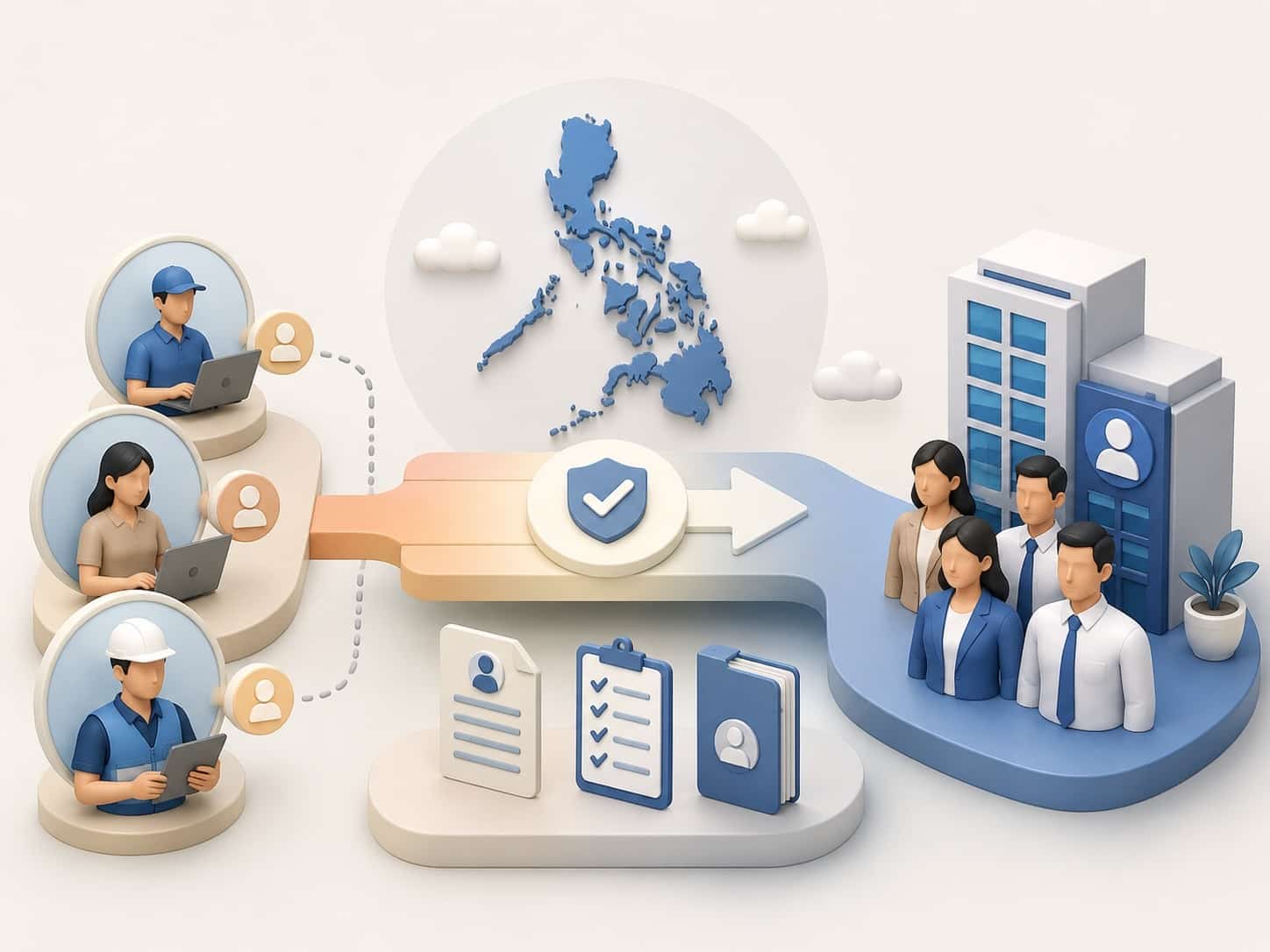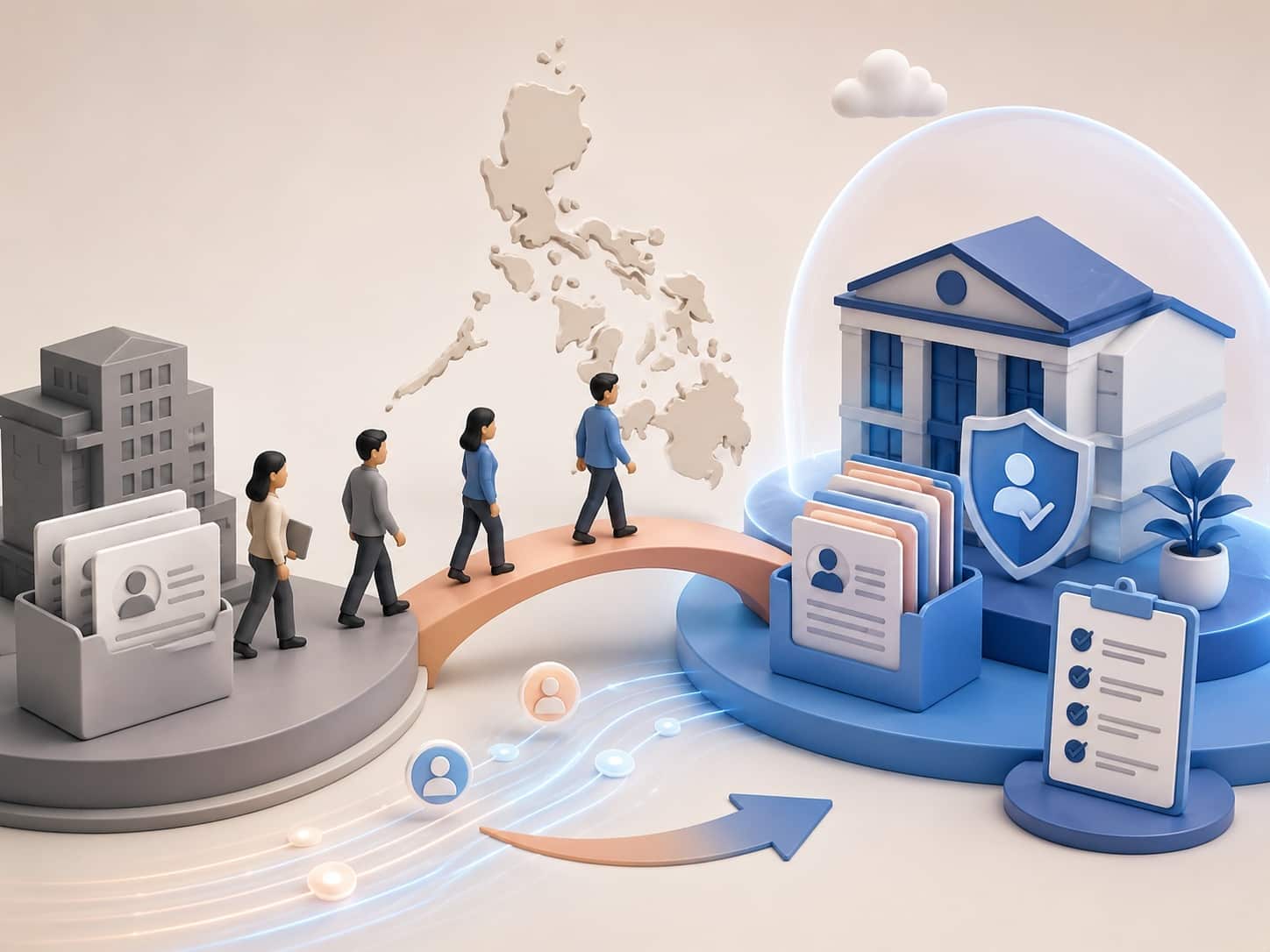
Switch from Rippling EOR to a Philippines EOR: 2026 Migration Guide
Author: Martin English
Published: June 8, 2026
TL;DR: Should you switch from Rippling EOR to a Philippines EOR?
Switching from Rippling EOR to a local Philippines EOR may make sense if your workforce is now mainly based in the Philippines and you want more local payroll support, clearer cost visibility, hands-on employee coordination, and a provider focused specifically on Philippine employment administration.
Rippling is commonly positioned as a global workforce platform that brings HR, payroll, compliance, IT, finance, employee data, and automation into one system. That model can be useful when a company wants a broad operating platform for domestic and international teams.
A local Philippines EOR may be a better fit when your team is Philippines-heavy and your priority is practical support around payroll cutover, employee communication, statutory contributions, benefits, 13th month pay, and compliance documentation.
This is not a “Rippling is bad” decision. It is a provider-fit decision. The right question is whether your current global workforce platform still matches how your Philippine team operates today.
The safest way to switch is through a structured migration plan covering notice periods, employee consent, payroll cutover, final pay, 13th month accruals, benefits continuity, statutory records, platform dependencies, and a post-switch proof pack.
For a broader switching framework, see Switching EOR Providers in the Philippines in 30 Days.
Quick answer: when should you switch from Rippling EOR to a local Philippines EOR?
You should consider switching from Rippling EOR to a local Philippines EOR if most of your EOR employees are in the Philippines, your team needs more local payroll and HR support, and you want a provider focused on Philippine employment compliance rather than a broad global HR, IT, finance, and workforce management system.
A global platform can be useful when you want employee data, payroll, HR workflows, IT provisioning, finance tools, and global reporting in one place. A local Philippines EOR can be more practical when the Philippines is your main hiring location and your biggest risks are payroll continuity, statutory contributions, employee communication, benefits, and documentation.
Before switching, check your current agreement, notice period, payroll dates, benefits end dates, employee records, platform dependencies, data export requirements, and any transition or offboarding obligations. If the migration is handled properly, employees should experience continuity in salary, role, management, and day-to-day work.
If you are comparing local and global models, start with Best Local EOR Philippines: Local vs Global.
Who is this guide for?
This guide is for companies that already use Rippling EOR or another global workforce platform for Filipino employees and are reviewing whether a local Philippines EOR would be a better fit.
It is especially relevant for:
- Australian, UK, US, Singapore, or global companies with employees in the Philippines
- companies that started with one or two Filipino hires and are now scaling
- teams that want more local payroll and statutory support
- employers that do not need a broad global HR, IT, and finance platform for a Philippines-only team
- finance, accounting, SaaS, professional services, and operations teams
- employers that need clearer cost breakdowns and compliance proof
- businesses planning to move employees between EOR providers without disruption
- companies comparing a Rippling EOR alternative in the Philippines
If your team is still spread across many countries and you rely heavily on Rippling’s wider platform for HR, IT, finance, permissions, integrations, and reporting, staying with a global platform may remain the better fit. If your hiring is now concentrated in the Philippines, a local EOR review is reasonable.
Rippling EOR vs local Philippines EOR: what is the real difference?
Rippling is a global workforce platform that includes EOR, payroll, HR, IT, finance, reporting, and workflow automation capabilities. A local Philippines EOR is usually more focused on in-country employment administration, payroll, statutory compliance, and employee support for Filipino staff.
Neither model is automatically better. The better choice depends on your hiring footprint, platform needs, support expectations, and how much local support your Philippine team now requires.
| Comparison area | Rippling EOR / global workforce platform | Local Philippines EOR |
| Best fit | Companies that want HR, payroll, IT, finance, and global workforce tools in one system | Companies hiring mainly or only in the Philippines |
| Main advantage | Broad platform coverage, workforce data, automation, reporting, and global workflows | Local payroll, HR support, statutory handling, and employee coordination |
| Support model | Platform-led support with global employment infrastructure | Local account management and Philippine employment support |
| Cost model | May include platform modules, global payroll, EOR, HRIS, IT, finance, or related tools | Often simpler for Philippines-only or PH-heavy teams |
| Employee experience | Standardised global platform process | More localised support for Filipino employees |
| Compliance focus | Multi-country employment and workforce compliance | Philippine payroll, labour, benefits, tax, and statutory administration |
| Best question to ask | “Do we need a broad global workforce platform?” | “Do we need stronger local execution in the Philippines?” |
A global platform can be valuable when your company wants one operating system across several countries and business functions. A local Philippines EOR can be more practical when the Philippines is the main or only hiring country and most support questions are local.
For a broader provider comparison, see Employer of Record Providers in the Philippines.
Are you replacing Rippling EOR, or replacing Rippling as a platform?
Before switching, separate the EOR decision from the broader platform decision.
Some companies use Rippling mainly for EOR and payroll. Others rely on it for HRIS, IT provisioning, finance workflows, app access, device management, approvals, reporting, or integrations.
That distinction matters.
If you still rely on Rippling for HRIS, IT, finance, or reporting, switching EOR providers does not automatically mean replacing the whole platform. You may decide to:
- move only the Philippines EOR layer to a local provider
- keep some Rippling platform functions for internal HR, IT, or reporting
- replace both the EOR and wider platform over time
- run a phased migration to avoid disruption
This is why Rippling-related EOR migrations should include both employment continuity and systems handover planning.
When does it make sense to consider switching from Rippling EOR?
It may make sense to review your Rippling EOR setup when your current model no longer matches your Philippine team size, local support needs, cost expectations, or compliance requirements.
You may want to assess a local Philippines EOR if:
- most of your EOR employees are now in the Philippines
- you want more hands-on local HR and payroll support
- you need clearer visibility over salaries, statutory contributions, benefits, and pass-through charges
- employees need help with payslips, government contributions, tax forms, or HMO questions
- you want stronger local documentation around SSS, PhilHealth, Pag-IBIG, BIR, and 13th month pay
- your team is scaling and you need a repeatable Philippines hiring model
- you want a provider that can support payroll cutover and employee communications during migration
- you need proof packs for finance, HR, board, investor, or compliance review
- your Philippines team no longer needs a broad HR, IT, and finance platform as much as local employment execution
This is a fit-based decision. The question is not whether Rippling works as a global workforce platform. The question is whether a Philippines-first provider would now serve your local team better.
If your priority is provider switching rather than first-time EOR setup, review Best EOR for Switching EOR Providers in the Philippines.
When should you stay with Rippling EOR?
Switching is not always the right answer.
Staying with Rippling EOR or another global workforce platform may make sense if:
- your workforce is spread across many countries
- you value one centralised system for HR, payroll, IT, finance, and reporting
- your Philippines headcount is small
- your current payroll and support process works well
- your employees are satisfied with the current support model
- your current cost structure is acceptable
- switching would create more disruption than benefit
- your current agreement has exit terms that make switching impractical right now
- your internal team relies heavily on Rippling workflows, permissions, integrations, devices, or reporting
You should not switch only because a local provider has a lower monthly admin fee. A lower fee is useful only if the provider also gives the right payroll accuracy, employee support, compliance documentation, benefits continuity, and migration process.
A good EOR decision balances cost, control, continuity, compliance, platform dependency, and employee experience.
What should you check before switching from Rippling EOR?
Before switching from Rippling EOR to a local Philippines EOR, review your current agreement, employee contracts, payroll calendar, benefits setup, transfer process, notice requirements, data handover process, platform dependencies, and any offboarding requirements.
| Area to check | Why it matters | What to ask |
| Current provider agreement | Avoid surprise timing issues, notice gaps, or fees | What notice period applies? Are there exit, offboarding, or module-related conditions? |
| Current legal employer | Determines the correct transfer process | Who is the current legal employer of the Filipino employees? |
| Employee contracts | Helps avoid inconsistent terms | What compensation, leave, benefits, and role terms are currently documented? |
| Payroll cycle | Prevents missed or duplicate salary payments | What is the last payroll date under the outgoing provider? |
| Final pay items | Avoids employee disputes | Who handles final salary, unused leave, reimbursements, and adjustments? |
| 13th month accrual | Required for Philippine employees | Has 13th month been accrued, paid, transferred, or settled? |
| Statutory contributions | Protects continuity | Are SSS, PhilHealth, and Pag-IBIG records available? |
| BIR documentation | Supports tax compliance | Who will issue tax documentation for the relevant employment period? |
| Benefits and HMO | Avoids coverage gaps | When does current coverage end and when does new coverage begin? |
| Platform dependencies | Prevents operational disruption | Are HRIS, IT, finance, reporting, permissions, or integrations tied to Rippling? |
| Employee consent | Reduces employment-relations risk | What documents must employees review and sign? |
| Data handover | Enables accurate onboarding | What payroll, identity, tax, bank, HR, and reporting data can be exported? |
| Communication plan | Protects employee confidence | When and how will employees be informed? |
Do not start the migration until these items are clear.
If the main reason for switching is cost, compare the full employment cost rather than only the admin fee. Use EOR Pricing in the Philippines to review the common components.
Cost comparison: Rippling EOR vs local Philippines EOR
When reviewing Rippling EOR against a local Philippines EOR, compare the full monthly employment cost, not only the visible EOR or platform fee.
A safe cost comparison should be neutral and evidence-based. Do not assume one provider is automatically cheaper or better. Compare what is included, what is excluded, and what support you actually receive.
| Cost item | Why it matters during a switch | What to compare |
| Monthly EOR or platform fee | Determines recurring provider cost | EOR fee, platform modules, billing currency, inclusions, and service scope |
| Employee gross salary | Usually the largest cost | Salary in PHP, AUD, USD, GBP, or other billing currency |
| Employer statutory contributions | Must be budgeted separately from salary | SSS, PhilHealth, Pag-IBIG, and other employer-side items |
| 13th month accrual | Required for Philippine employees | Whether it is accrued monthly, billed separately, or included in estimates |
| HMO and benefits | Affects employee continuity | Coverage, dependants, start date, waiting periods |
| FX and billing currency | Can affect monthly predictability | PHP-to-AUD/USD/GBP conversion, spread, timing |
| Platform dependencies | May affect total switching cost | HRIS, payroll, IT, finance, reporting, integrations, or device management |
| Onboarding fees | Affects migration cost | Per employee or one-time setup fees |
| Offboarding or transition fees | Affects business case for switching | Current provider exit charges or final billing |
| Payroll support scope | Determines real value | Adjustments, reimbursements, payslip support, employee queries |
| Reporting and proof packs | Important for finance and compliance | Payroll registers, contribution summaries, tax documentation |
For Philippines-heavy teams, a local EOR may be more cost-effective if it offers a simpler fee structure and localised support. For companies using Rippling as a broader workforce platform, the cost comparison should also consider what systems would need to remain, be replaced, or be simplified after the switch.
If you still rely on Rippling for HRIS, IT, finance, or reporting, separate the EOR decision from the wider platform decision. Moving the Philippines EOR layer to a local provider may reduce employment-administration complexity, but it does not automatically replace every system function your team uses.
The better question is not:
“Which provider has the lowest headline fee?”
The better question is:
“Which provider gives the right level of cost clarity, payroll support, compliance documentation, platform fit, and employee continuity for our Philippine team?”
How to switch from Rippling EOR to a local Philippines EOR
A safe migration should be planned as a controlled employment transition, not a sudden provider replacement.
Step 1: Confirm the switching scope
Be clear on what you are changing.
Are you replacing only the Philippines EOR layer, or are you also moving HRIS, IT, finance, reporting, approval workflows, or integrations away from Rippling?
Common reasons for switching the EOR layer include stronger local payroll support, clearer cost visibility, improved employee communication, local HR documentation, easier benefits coordination, and better fit for a Philippines-heavy team.
A clear scope helps you decide whether switching is actually worth it and prevents accidental disruption to wider systems.
Step 2: Review current contracts and notice periods
Check your current Rippling agreement and employee documentation.
Confirm:
- provider notice periods
- termination or transition clauses
- final payroll obligations
- benefits end dates
- employee data access
- invoicing cut-off dates
- offboarding steps
- platform module dependencies
- confidentiality and data protection obligations
This helps avoid a rushed transfer.
Step 3: Build the employee and platform handover file
Prepare a clean employee register with:
- full legal name
- job title
- start date
- current salary
- allowance structure
- payroll frequency
- benefits
- accrued leave
- 13th month accrual status
- work location
- employment status
- manager
- bank details
- government IDs where required
- equipment or reimbursement notes
- current platform access or workflow dependencies
This becomes the core migration file for the incoming EOR and helps your internal team identify what needs to be exported, retained, or replaced.
Step 4: Choose a clean payroll cutover date
The payroll cutover date is the most important operational decision.
The goal is to avoid missed salary payments, duplicated payments, incorrect deductions, gaps in statutory contributions, unclear leave balances, final pay confusion, and benefits coverage gaps.
A common approach is to make the new EOR effective at the start of a payroll month or clean payroll period.
For a full cutover workflow, use Switching EOR Providers in the Philippines in 30 Days.
Step 5: Prepare employee communications
Employees should not hear about the switch at the last minute.
Explain:
- why the provider is changing
- what will stay the same
- what will change
- who the new legal employer will be
- when new contracts will be issued
- how payroll will continue
- what happens to benefits
- who to contact for questions
Keep the message calm and practical. The main employee concern is continuity.
Step 6: Issue new employment documents and transfer records
The local EOR should prepare compliant Philippine employment documents, including:
- employment agreement
- job description or role schedule
- compensation details
- benefits summary
- confidentiality and data clauses
- company policy acknowledgements
- payroll forms
- government registration information where required
The new EOR also needs accurate information to run payroll correctly from day one. At minimum, prepare salary details, tax identification information, government contribution details, bank details, leave balances, allowances, benefits status, payroll cut-off instructions, final pay notes, signed documents, and prior payroll records where available.
Employees should have time to review and ask questions before signing.
Step 7: Confirm benefits and systems continuity
If employees have HMO or other benefits, confirm whether coverage will continue, be replaced, or restart under the new provider.
Document the old benefits end date, new benefits start date, dependants, waiting periods, employee communications, and claims handling during the transition period.
At the same time, review any remaining system dependencies, including HRIS records, reporting exports, time off data, employee documents, device or app provisioning, finance workflows, approval chains, integrations, and access permissions.
Benefits and systems uncertainty can create employee anxiety and operational disruption, so both should be settled before cutover.
Step 8: Validate first payroll and request proof pack
The first payroll under the new EOR should be reviewed before payment.
Check gross salary, allowances, reimbursements, deductions, statutory contributions, net pay, payslip format, leave balances, 13th month accrual, bank details, employee names, and tax details.
After the first payroll, ask the new EOR for a proof pack. This may include signed employment documents, employee master list, payroll register, payslips, statutory contribution summary, benefits enrolment confirmation, tax documentation status, leave balance record, and an issue log.
This gives your finance, HR, and leadership teams confidence that the migration is complete.
Suggested 30-day migration timeline
| Timeline | Action | Owner |
| Days 1–3 | Review current Rippling agreement, notice terms, employee list, payroll dates, and platform dependencies | Client HR / Finance / Ops |
| Days 4–7 | Compare local EOR proposal, cost breakdown, service scope, and migration plan | Client + incoming EOR |
| Days 8–10 | Confirm go/no-go decision and target cutover date | Client leadership |
| Days 11–15 | Prepare employee communications, data handover, and platform export plan | Client HR + incoming EOR |
| Days 16–20 | Issue new contracts and collect employee documents | Incoming EOR |
| Days 21–25 | Confirm payroll setup, benefits, statutory handling, bank details, and system handover | Incoming EOR + client finance |
| Days 26–30 | Complete cutover, validate first payroll, and prepare proof pack | Incoming EOR |
Some migrations can be faster, while others need more time depending on employee count, notice periods, contract terms, benefits, data readiness, and platform dependency.
What should stay the same, and what can change?
A good EOR switch should feel controlled and low-disruption for employees.
Where possible, keep the employee’s role, manager, salary, working schedule, tools, reporting lines, communication channels, approved leave, and support contacts stable.
Some items may change depending on the new EOR setup, including the employment contract format, payroll cut-off date, payslip format, HR support process, HMO provider, benefits structure, leave tracking, reimbursement process, statutory documentation workflow, invoice format, and reporting cadence.
For Rippling users, some non-EOR workflows may also need to be reviewed, such as HRIS records, IT access, expense workflows, approval chains, and reporting dashboards.
The legal employer and payroll administrator may change, but the employee’s day-to-day work should remain familiar.
Sample employee message for a Rippling-to-local-EOR switch
Use clear, calm, neutral language.
We are updating our Philippines employment administration provider to improve local payroll support, HR coordination, and employment documentation. Your role, manager, day-to-day responsibilities, and agreed compensation are expected to continue. You will receive updated employment documents and a clear transition timeline. We will also share who to contact for payroll, benefits, and HR questions before the change takes effect.
Avoid suggesting that the change is due to provider failure unless there is a documented legal reason to say so. Most employee communication should focus on continuity.
Risks to avoid when moving from Rippling EOR to another EOR
The biggest risks are operational, not just legal.
Avoid these mistakes:
- switching without checking notice periods
- comparing providers only on headline admin fee
- failing to separate the EOR decision from the wider platform decision
- failing to review HRIS, IT, finance, reporting, or platform dependencies
- failing to align payroll cut-off dates
- not explaining the change to employees
- losing track of leave balances
- missing 13th month accruals
- allowing HMO coverage gaps
- assuming employee data will transfer automatically
- failing to document final pay responsibilities
- not checking statutory contribution records
- starting the new EOR before contracts are signed
- failing to validate first payroll
- not requesting a post-switch proof pack
The migration should be treated like a payroll, employment continuity, and systems handover project, not just a vendor replacement.
What to ask a local Philippines EOR before switching
Before choosing a new provider, ask:
- Have you migrated employees from another EOR before?
- Who becomes the legal employer in the Philippines?
- What is included in your monthly EOR fee?
- How do you handle SSS, PhilHealth, Pag-IBIG, BIR withholding, and 13th month pay?
- How do you prevent payroll gaps during cutover?
- What happens to HMO or benefits during the switch?
- What documents do employees need to sign?
- What proof pack do you provide after first payroll?
- What data do you need from our current HRIS or EOR platform?
- How do you support employee questions during and after migration?
These questions help you compare actual migration capability, not just EOR pricing.
Why Smart Outsourcing Solution for Philippines EOR migration?
Smart Outsourcing Solution is a Philippines-first EOR and outsourcing partner for companies that want local employment support without setting up a Philippine entity.
For Philippines-heavy teams, SOS is designed around local execution rather than broad multi-country platform coverage. That can be useful if your priority is:
- local Philippine employment administration
- compliant employment contracts
- payroll processing
- payslips
- SSS, PhilHealth, and Pag-IBIG handling
- BIR withholding support
- 13th month pay administration
- employee communication
- benefits coordination
- provider-to-provider migration support
- dedicated local account management
- clear Philippines EOR pricing
SOS provides a local EOR model for companies that want employment administration, payroll support, statutory handling, and employee coordination in the Philippines without opening their own entity.
SOS is designed for companies that need Philippines-specific employment administration. It is not a full HRIS, IT, finance, or global workforce platform replacement. For companies that still need those wider tools, the best approach may be to separate the EOR decision from the broader platform decision.
SOS is not trying to replace the value of a broad workforce platform for companies that need HR, IT, finance, and global reporting in one system. It is a better-fit option for companies whose main workforce requirement is now the Philippines.
To compare the local model with global EOR options, see Employer of Record Providers in the Philippines.
Related resources
- Switching EOR Providers in the Philippines in 30 Days
- Best EOR for Switching EOR Providers in the Philippines
- Best Local EOR Philippines: Local vs Global
- Employer of Record Services in the Philippines
- EOR Pricing in the Philippines
- Cheapest EOR Provider in the Philippines
FAQs
What is the best Rippling EOR alternative for hiring in the Philippines?
The best Rippling EOR alternative depends on your hiring footprint and platform needs. If you need HR, payroll, IT, finance, automation, and global reporting in one system, Rippling may still be the better fit. If most of your employees are in the Philippines, a local Philippines EOR may be more practical because it can focus on local payroll, statutory contributions, employee support, benefits, and compliance documentation.
Is Rippling better than a local Philippines EOR?
Rippling may be better if your company needs a broad global workforce platform with HR, payroll, IT, finance, automation, and reporting across several markets. A local Philippines EOR may be better if your workforce is mainly in the Philippines and your priority is local payroll, employee support, benefits continuity, statutory documentation, and clear Philippines-specific cost visibility.
Can I move employees from Rippling EOR to a local Philippines EOR without ending their roles?
Yes. A provider switch does not need to end the employee’s day-to-day role. The legal employer and payroll administrator may change, but the employee’s manager, duties, compensation, and working arrangement can usually remain consistent if the migration is planned properly.
Do I need to replace Rippling entirely if I switch EOR providers?
Not necessarily. Some companies may move only the Philippines EOR layer to a local provider while keeping other HRIS, IT, finance, reporting, or workflow tools in place. The key is to separate the EOR decision from the wider platform decision before starting the migration.
How do I compare Rippling EOR with a local Philippines EOR?
Compare Rippling EOR and a local Philippines EOR based on your actual needs: platform coverage, payroll support, pricing structure, benefits handling, employee communication, statutory documentation, local account management, migration support, and system dependencies. Do not compare only the headline monthly fee.
Is switching from Rippling EOR to a local Philippines EOR risky?
It can be risky if handled poorly. Common risks include missed payroll, duplicated salary payments, benefits gaps, unclear final pay, missing 13th month accruals, incomplete employee data, poor communication, and unexpected disruption to platform workflows. These risks can be reduced with a structured migration plan and a clean payroll cutover date.
How long does it take to switch from Rippling EOR to another EOR in the Philippines?
A well-prepared migration can often be planned around a 30-day timeline, but the actual timing depends on notice periods, employee count, payroll dates, contract terms, benefits setup, platform dependencies, and how quickly employee data can be prepared.
What happens to 13th month pay during an EOR switch?
13th month pay should be reviewed before the cutover. The outgoing and incoming provider responsibilities should be documented clearly, including whether accrued amounts are paid out, transferred, or reflected in the new payroll setup.
Final takeaway
Switching from Rippling EOR to a local Philippines EOR can make sense when your team is now Philippines-heavy and you want more local payroll support, clearer cost visibility, stronger employee coordination, and a provider model built around Philippine employment administration.
It does not mean Rippling is the wrong provider for every company. Rippling or another global workforce platform may still be suitable if you need broad international coverage, HRIS, IT, finance, automation, and reporting in one system.
The key is to switch only when the business case is clear and the migration is controlled. Review your current contract, align payroll dates, communicate clearly with employees, protect benefits continuity, confirm 13th month treatment, validate first payroll, review platform dependencies, and ask the incoming EOR for a post-switch proof pack.
Ready to review your EOR switch?
Planning to move employees from Rippling EOR or another global workforce platform to a local Philippines EOR? Contact Smart Outsourcing Solution to review your payroll cutover, employee communication plan, systems handover, and compliance handover before making the switch.