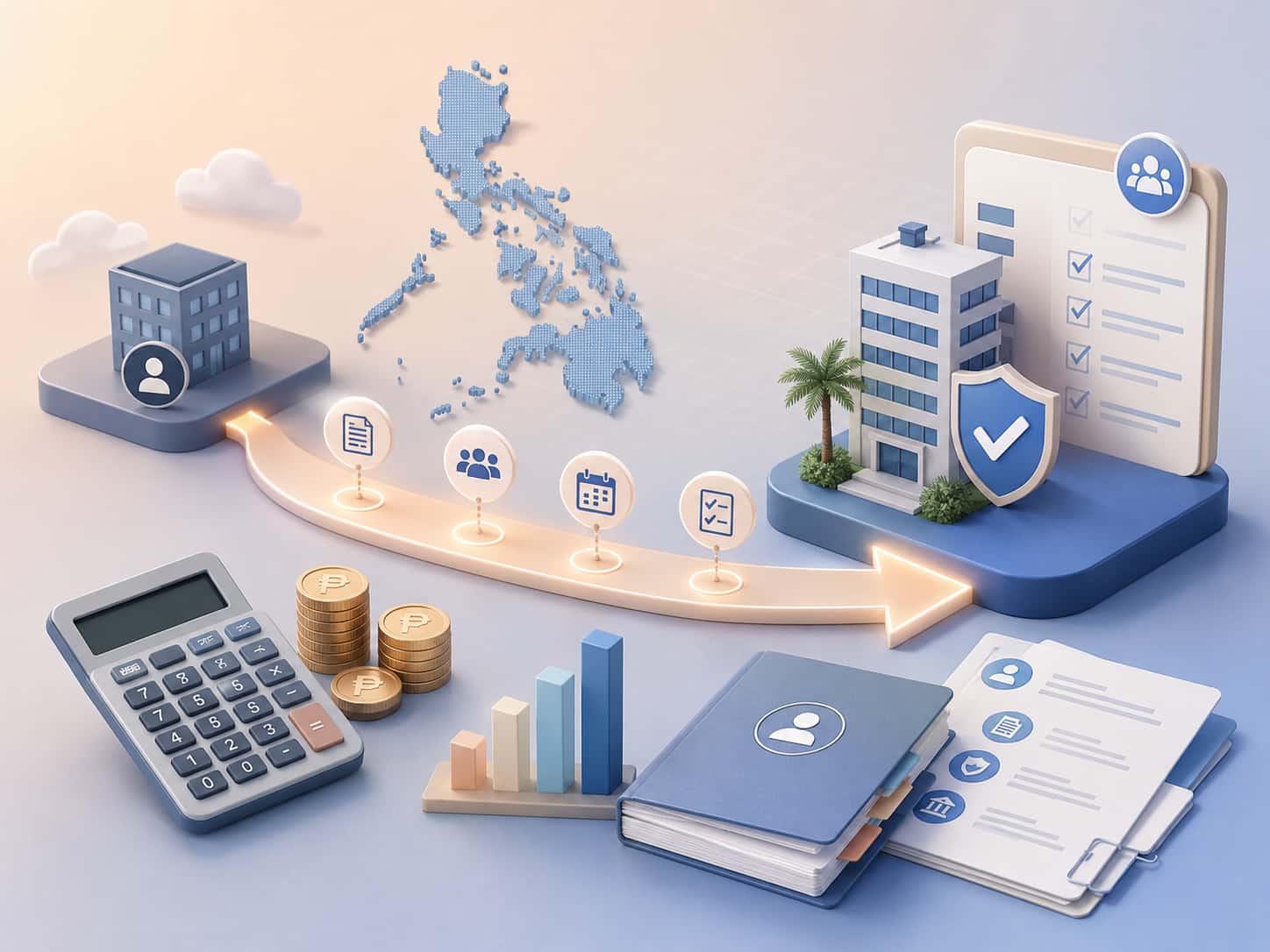
Philippines EOR for Scaling Teams (20–500+): A Complete Playbook
Author: Martin English, CEO & Founding Partner
Updated: May 28, 2026
Disclosure: Informational only. Not legal, tax, or financial advice.
TL;DR
A Philippines Employer of Record can help companies scale from 20 to 500+ employees without setting up a local entity, but the operating model must mature as headcount grows.
At 1–10 employees, an EOR mainly solves hiring speed, payroll setup, and local employment administration.
At 20–50 employees, the EOR must support predictable payroll cut-offs, statutory contribution accuracy, benefits administration, clean documentation, and manager coordination.
At 100–500+ employees, the EOR must provide audit-ready reporting, remittance evidence, payroll registers, employee-level documentation, structured HR case handling, and governance cadence.
A compliant Philippines EOR should provide:
| Compliance Proof | Why It Matters |
| DOLE-aligned employment contracts | Shows each employee has a proper local employment structure |
| Payroll registers | Shows salary, deductions, allowances, net pay, and pay cycle |
| Payslips | Gives employee-facing payroll transparency |
| SSS contribution evidence | Shows social security contribution handling |
| PhilHealth contribution evidence | Shows health insurance contribution handling |
| Pag-IBIG contribution evidence | Shows housing fund contribution handling |
| 13th-month pay records | Shows mandatory annual pay is tracked and paid correctly |
| Remittance receipts or summaries | Supports audit, finance review, and due diligence |
| BIR withholding documentation | Supports tax withholding and year-end reconciliation |
| Final pay and offboarding records | Reduces exit disputes and access risk |
The larger the team, the more dangerous informal payroll, weak statutory tracking, and vague “we handle compliance” claims become.
For the full compliance standard, see Philippines EOR Compliance.
Quick Answer
A Philippines EOR is a local legal employer that hires employees in the Philippines on behalf of a foreign company. The EOR handles local employment contracts, payroll, statutory contributions, 13th-month pay, payslips, and HR compliance support while the client company manages day-to-day work.
For scaling teams, the most important question is not only “Can the EOR hire employees?” It is:
Can the EOR support payroll, documentation, statutory remittances, HR cases, and audit evidence at 20, 100, 300, or 500+ employees without breaking?
Use this rule of thumb:
| Headcount | Main EOR Requirement |
| 1–10 | Fast compliant hiring and payroll setup |
| 20–50 | Payroll rhythm, documentation, benefits, manager support |
| 50–100 | Reporting, employee lifecycle controls, HR case process |
| 100–250 | Audit readiness, structured governance, escalation paths |
| 250–500+ | Enterprise-grade reporting, risk controls, entity strategy, compliance evidence |
Who This Playbook Is For
This playbook is for companies that are already hiring, or planning to scale, Philippine teams beyond a few individual hires.
It is especially relevant for:
- founders moving from contractor teams to employee teams
- CFOs reviewing payroll and statutory risk
- COOs scaling offshore delivery teams
- HR leaders building Philippine employment infrastructure
- customer support teams moving toward 24/7 coverage
- BPO-alternative teams that want direct employee control
- SaaS, ecommerce, agency, finance, operations, and technical teams scaling in the Philippines
- companies deciding whether to continue with EOR or open their own Philippine entity
This is not a generic “what is EOR?” guide. It is a scaling playbook for teams where payroll accuracy, statutory proof, HR process, and audit readiness start to matter.
What Is a Philippines EOR?
A Philippines Employer of Record is a local legal employer that hires employees in the Philippines on behalf of a foreign company.
The EOR handles the local employment layer. The client company manages the role, work, tools, performance, and business outcomes.
| Responsibility | Client Company | Philippines EOR |
| Selects the worker | Yes | May support |
| Manages daily work | Yes | No |
| Sets role, tools, KPIs, and priorities | Yes | No |
| Employs the worker locally | No | Yes |
| Issues employment contract | No | Yes |
| Runs payroll | No | Yes |
| Issues payslips | No | Yes |
| Handles SSS, PhilHealth, Pag-IBIG | No | Yes |
| Handles 13th-month pay | No | Yes |
| Maintains employment records | Reviews | Yes |
| Supports HR and offboarding | Coordinates | Yes |
An EOR is useful when a company wants Philippine employees without immediately opening a Philippine entity.
Why Scaling Through EOR Is Different From Hiring One or Two People
Hiring one employee through an EOR is mostly an onboarding and payroll setup exercise.
Scaling to 20–500+ employees is different. At that point, the EOR becomes part of the company’s operating infrastructure.
| Scale Stage | What Changes |
| 1–10 employees | Basic onboarding, contracts, payroll, and support are enough |
| 20–50 employees | Payroll cut-offs, employee questions, benefits, and reporting become recurring operations |
| 50–100 employees | HR cases, leave records, statutory tracking, and documentation must be structured |
| 100–250 employees | Internal finance, HR, and leadership need reliable reporting and escalation paths |
| 250–500+ employees | Audit readiness, governance cadence, compliance evidence, and entity strategy become board-level concerns |
At scale, small payroll errors become large liabilities. One incorrect payroll setup can affect every employee every pay cycle.
The Core Compliance Stack for Philippines EOR Teams
Every EOR-backed employee in the Philippines should sit inside a documented compliance stack.
| Layer | What It Covers | Proof to Request |
| Employment contract | Local employment terms, role, salary, probation, benefits | Signed DOLE-aligned contract |
| Payroll | Salary, deductions, net pay, allowances | Payroll register and payslips |
| SSS | Social security contribution administration | Contribution evidence or remittance summary |
| PhilHealth | Health insurance contribution administration | Contribution evidence or remittance summary |
| Pag-IBIG | Housing fund contribution administration | Contribution evidence or remittance summary |
| 13th-month pay | Mandatory annual pay | Accrual and payment record |
| Tax withholding | Salary tax withholding and year-end reconciliation | BIR documentation and annual tax forms where applicable |
| Leave and holidays | Local leave and holiday handling | Leave records |
| Offboarding | Final pay, documents, exit process | Final pay and offboarding records |
For the full standard, see Philippines EOR Compliance.
What Compliance Proof Should a Philippines EOR Provide?
A credible Philippines EOR should be able to show evidence, not just give assurances.
| Proof Item | Why It Matters |
| Sample employment contract | Shows the local employment structure |
| Sample payslip | Shows employee-facing payroll transparency |
| Payroll register format | Helps finance review payroll details |
| SSS remittance evidence or summary | Shows social security handling |
| PhilHealth remittance evidence or summary | Shows health insurance contribution handling |
| Pag-IBIG remittance evidence or summary | Shows housing fund contribution handling |
| 13th-month calculation method | Shows accrual, proration, and payment logic |
| BIR withholding process | Shows tax withholding and year-end reconciliation process |
| Leave and holiday treatment | Shows local HR administration |
| Offboarding workflow | Shows final pay and exit handling |
| HR escalation process | Shows how disputes and employee concerns are managed |
| Audit report pack | Shows whether the provider can support due diligence |
At 20 employees, these records are useful. At 200 employees, they are essential.
Payroll Compliance: What Has to Work Every Cycle
Payroll compliance is not just paying salary. It requires accurate calculation, approval, documentation, remittance, and reporting.
| Payroll Item | What Should Be Documented |
| Gross salary | Agreed pay for the payroll period |
| Allowances | Internet, equipment, night shift, transport, or role-specific allowances |
| Deductions | Statutory and approved deductions |
| Employer contributions | Employer-side statutory obligations |
| Employee contributions | Employee-side statutory deductions |
| Net pay | Final amount paid to employee |
| Payslip | Employee-facing payroll record |
| Payroll register | Finance-facing payroll record |
| 13th-month accrual | Monthly accrual and annual payment treatment |
| Remittance evidence | SSS, PhilHealth, Pag-IBIG, and tax records or summaries |
| Approval trail | Review and sign-off before payroll release |
A scaling EOR should have a payroll calendar, cut-off rules, approval process, correction workflow, and reporting cadence.
Statutory Benefits for Philippines Employees
Philippines-based employees generally require administration of the following employment and payroll items.
| Statutory / Payroll Item | Why It Matters |
| SSS | Social security contribution administration |
| PhilHealth | Health insurance contribution administration |
| Pag-IBIG | Housing fund contribution administration |
| 13th-month pay | Mandatory annual pay for covered employees |
| Payslips | Payroll transparency and employee documentation |
| Payroll records | Audit, finance, and employee support |
| Leave records | Workforce planning and HR documentation |
| Final pay records | Clean offboarding and dispute prevention |
Professional-grade teams often add HMO, allowances, paid leave enhancements, performance bonuses, training allowances, and equipment support. These should be documented and handled correctly in payroll.
Headcount Stages: What Changes From 20 to 500+
Stage 1: 20–50 Employees
At 20–50 employees, the company has moved beyond individual hiring. The main challenge is creating rhythm.
| Priority | What to Implement |
| Payroll cut-offs | Fixed payroll deadlines and change submission rules |
| Manager coordination | One owner per function or team |
| Employee records | Clean contracts, job titles, salary, benefits, and start dates |
| Payslip support | Employee questions answered quickly |
| Benefits tracking | Clear records of HMO, allowances, leave, and reimbursements |
| Compliance proof | Monthly payroll and statutory evidence available on request |
At this stage, the EOR should stop feeling like a vendor and start acting like employment infrastructure.
Stage 2: 50–100 Employees
At 50–100 employees, governance becomes more important.
| Priority | What to Implement |
| HR case handling | Clear process for employee concerns, warnings, performance issues |
| Role and salary governance | Approval process for raises, promotions, and changes |
| Leave reporting | Team-level leave visibility |
| Payroll variance review | Month-on-month payroll change checks |
| Employee lifecycle tracking | Onboarding, probation, regularisation, changes, offboarding |
| Statutory reporting | Regular remittance summaries or evidence pack |
At this stage, finance and HR should review EOR reports monthly.
Stage 3: 100–250 Employees
At 100–250 employees, payroll and HR failures become material.
| Priority | What to Implement |
| Audit-ready payroll pack | Payroll register, payslips, remittance summaries, variance notes |
| HR governance meetings | Monthly or quarterly EOR review |
| Benefits administration | Standardized benefits policy and exceptions process |
| Offboarding controls | Final pay, access removal, documentation, equipment return |
| Manager training | Local employment basics for foreign managers |
| Compliance dashboard | Headcount, payroll, benefits, remittances, cases, offboarding |
At this stage, an EOR should provide structured reporting, not ad hoc explanations.
Stage 4: 250–500+ Employees
At 250–500+ employees, the company should review whether EOR remains the right structure or whether a Philippine entity should be considered.
| Priority | What to Implement |
| Entity strategy review | Compare EOR vs own entity cost, control, and risk |
| Enterprise payroll governance | Formal payroll approval and audit process |
| HR policy maturity | Employee handbook, benefits matrix, disciplinary process |
| Workforce analytics | Attrition, salary changes, role mix, cost per function |
| Compliance audit readiness | Evidence pack available for internal or external review |
| Escalation framework | Named owners for payroll, HR, legal, finance, and operations |
EOR can still work at 500+ employees if the provider has the infrastructure. But the decision should be intentional, not accidental.
When to Stay With EOR vs Open a Philippine Entity
| Factor | Stay With EOR | Consider Own Entity |
| Headcount | 1–100, sometimes 250+ | Usually stronger case at larger, permanent scale |
| Setup speed | Need fast hiring | Time available for setup |
| Local infrastructure | No local HR/payroll/legal team | Ready to build local infrastructure |
| Control | High day-to-day control is enough | Need full legal and operational control |
| Admin burden | Want lower admin burden | Willing to own payroll, HR, tax, legal |
| Cost | EOR fee acceptable | Entity economics become better at scale |
| Risk tolerance | Want EOR to handle local employment | Ready to own local employer risk |
| Strategy | Testing or scaling flexibly | Long-term Philippine operating base |
A common path is:
EOR → scaled EOR governance → entity review → entity setup or hybrid model
Related page: EOR vs Entity Setup.
EOR vs Contractor Teams at Scale
Contractor teams become riskier as they grow.
| Factor | Contractor Team | EOR Employee Team |
| Best for | Short-term, independent project work | Ongoing employee-like work |
| Employment contract | Usually none | Local employment contract |
| Payroll proof | Contractor invoices | Payslips and payroll records |
| Statutory benefits | Usually not handled | SSS, PhilHealth, Pag-IBIG, 13th-month handling |
| Misclassification risk | Higher if full-time and controlled | Lower when properly employed |
| Benefits | Usually none | Statutory and optional benefits |
| Offboarding | Contract-based | Local employment offboarding process |
| Audit defensibility | Weaker | Stronger |
If workers are full-time, managed by your team, using your tools, and following your schedule, an EOR employee model is usually cleaner than contractor arrangements.
Related page: EOR vs Freelancer Philippines.
Payroll Operations at Scale
Payroll Cut-Off Management
At scale, payroll cut-offs become critical.
A mature EOR should provide:
- monthly or semi-monthly payroll calendar
- cut-off dates for salary changes, allowances, reimbursements, overtime, and deductions
- named payroll owner
- approval workflow
- correction process
- off-cycle payroll rules
- escalation process for urgent changes
At 20 employees, missed payroll changes are manageable. At 200 employees, they create trust, finance, and compliance issues.
Payroll Variance Review
Every payroll cycle should include a variance review.
| Variance Item | Why It Matters |
| New hires | Confirms correct start date and salary |
| Leavers | Confirms final pay and deductions |
| Salary changes | Confirms approved increases or adjustments |
| Allowances | Confirms recurring or one-off amounts |
| Statutory deductions | Flags unusual contribution changes |
| Benefits | Confirms HMO, allowances, or reimbursements |
| Net pay changes | Helps catch errors before release |
A scaling team should not approve payroll blindly.
Payroll Evidence Pack
A monthly payroll evidence pack should include:
| Document | Purpose |
| Payroll register | Finance review and audit record |
| Payslip samples or employee payslip confirmation | Payroll transparency |
| Statutory contribution summary | SSS, PhilHealth, Pag-IBIG handling |
| 13th-month accrual report | Annual obligation tracking |
| Benefits and allowances report | Cost and entitlement tracking |
| Variance report | Explains changes from prior payroll |
| Invoice breakdown | Separates salary, statutory costs, benefits, and EOR fee |
| Open issues log | Tracks payroll corrections or employee questions |
For larger teams, this should be standardized and delivered every payroll cycle or monthly.
13th-Month Pay at Scale
13th-month pay is a mandatory annual benefit for covered employees in the Philippines.
At scale, the risk is not knowing that 13th-month pay exists. The risk is weak tracking, incorrect proration, and unclear accrual.
| 13th-Month Issue | What Can Go Wrong |
| Base salary confusion | Incorrectly using total compensation instead of basic salary |
| New hires | Incorrect proration for partial-year employment |
| Leavers | Missing prorated 13th-month in final pay |
| Salary changes | Incorrect treatment after compensation changes |
| Payroll accrual | Finance underestimates year-end obligation |
| Documentation | Employee disputes due to unclear calculation |
A strong EOR should show how 13th-month pay is calculated, accrued, paid, and documented.
SSS, PhilHealth, and Pag-IBIG at Scale
Statutory contribution handling becomes more complex as headcount grows because every employee must be correctly enrolled, calculated, deducted, remitted, and documented.
| Scheme | Scaling Risk | What to Ask the EOR |
| SSS | Incorrect contribution bracket, late remittance, enrolment gaps | Can you show employee-level contribution evidence? |
| PhilHealth | Incorrect rate, missed updates, salary base errors | How do you update contribution rates and reconcile changes? |
| Pag-IBIG | Enrolment delays, voluntary contribution errors | How do you document mandatory and voluntary contributions? |
The EOR should provide evidence or summaries showing that statutory contributions are handled correctly, not only included in a line item.
BIR Withholding and Year-End Reconciliation
For larger teams, tax withholding and year-end reconciliation require process discipline.
A scaling EOR should be able to explain:
- how salary withholding is calculated
- how payroll changes affect withholding
- how annualization is handled
- how year-end reconciliation is completed
- how employee tax documentation is prepared
- how corrections are handled
- what records are available to the client and employee
At scale, year-end tax documentation becomes a major employee trust issue. Late or inaccurate tax documents create avoidable HR problems.
Employment Contracts, Probation, and Regularisation
Employment documentation matters more as headcount grows.
| Area | What to Confirm |
| Employment contract | Local Philippine employment contract issued by the EOR |
| Role and salary | Clear role title, salary, benefits, and reporting structure |
| Probationary period | Standards documented at the start of employment |
| Regularisation | Clear review and confirmation process |
| Policies | Leave, holidays, confidentiality, IP, equipment, data handling |
| Performance issues | Documentation and notice process |
| Offboarding | Final pay, clearance, documents, and access removal |
A weak employment contract process can become a major risk when dozens or hundreds of employees are hired under the same template.
HR Case Handling at Scale
At 20+ employees, HR cases become normal. At 200+ employees, they require process.
| HR Case Type | Required Process |
| Attendance issues | Documentation, manager input, employee communication |
| Performance concerns | Standards, coaching, written records, review dates |
| Policy violations | Investigation, notices, evidence, escalation |
| Grievances | Intake, confidentiality, response timeline |
| Leave disputes | Records, approvals, policy reference |
| Salary or payroll complaints | Payroll investigation and correction workflow |
| Resignations | Exit acceptance, final pay, clearance |
| Terminations | Local legal process, notices, documentation |
The EOR should not only process payroll. It should support local employment lifecycle risk.
Offboarding and Final Pay
Offboarding is one of the highest-risk points in the employee lifecycle.
A proper EOR offboarding process should include:
| Offboarding Item | Why It Matters |
| Resignation or termination documentation | Shows lawful basis and timeline |
| Final pay calculation | Prevents salary and benefits disputes |
| Prorated 13th-month pay | Required where applicable |
| Leave balance treatment | Ensures correct final pay |
| Statutory records | Confirms payroll closure |
| Clearance process | Tracks equipment, documents, and obligations |
| Access removal checklist | Protects systems and data |
| Final payslip and record | Supports employee and audit documentation |
For scaling teams, offboarding should be a checklist, not an improvisation.
Data Security and Access Controls for Scaling Teams
EOR compliance and data security overlap because employees often access company systems, customer data, finance records, CRMs, repositories, support tools, and internal documents.
Minimum controls:
| Control | Why It Matters |
| Least-privilege access | Employees only access what their role requires |
| MFA | Protects tools, email, CRM, finance, and internal systems |
| Password manager | Prevents password sharing in chat or spreadsheets |
| Role-based permissions | Separates viewer, editor, admin, and owner access |
| Device policy | Sets standards for remote work devices |
| Access log | Tracks who has access to each system |
| PII handling SOP | Protects customer, employee, candidate, and vendor data |
| Offboarding access removal | Removes access immediately when workers leave |
Related page: Data Security & IP Protection in Offshore Teams.
Operating Cadence for Scaling EOR Teams
A scaling EOR relationship should have a formal cadence.
| Cadence | Meeting / Report | Purpose |
| Every payroll cycle | Payroll approval and variance review | Prevent pay errors |
| Monthly | Payroll and HR operations review | Review open issues and trends |
| Monthly | Headcount and cost report | Finance and workforce planning |
| Quarterly | Compliance evidence review | Confirm proof pack and audit readiness |
| Quarterly | Benefits and retention review | Improve employee experience |
| Quarterly | Access and offboarding review | Reduce data and system risk |
| Annually | Entity vs EOR review | Decide whether EOR remains the best structure |
The goal is not meetings for their own sake. The goal is predictable governance.
What to Ask a Philippines EOR Before Scaling Past 20 Employees
Ask these questions before scaling.
| Question | Why It Matters |
| Do you employ workers through your own Philippine entity? | Confirms who the legal employer is |
| Can you provide sample employment contracts? | Shows local contract quality |
| Can you provide sample payslips and payroll registers? | Shows payroll transparency |
| Can you provide SSS, PhilHealth, and Pag-IBIG evidence or summaries? | Shows statutory handling |
| How do you track 13th-month accrual and payment? | Prevents year-end surprises |
| What is your payroll cut-off process? | Prevents missed changes |
| How do you handle payroll corrections? | Shows operational maturity |
| How do you manage HR cases? | Shows lifecycle support |
| How do you handle offboarding and final pay? | Reduces exit disputes |
| What reports do we receive monthly? | Shows governance quality |
| Can you support 100+ or 500+ employees? | Tests scalability |
| When should we consider opening our own entity? | Shows strategic honesty |
A strong EOR will answer these directly and provide sample documentation.
Red Flags in a Scaling EOR Provider
| Red Flag | Why It Matters |
| Cannot show sample payslips | Weak payroll transparency |
| Cannot show remittance evidence or summaries | Weak statutory proof |
| Uses vague “local partner” language | Legal employer may be unclear |
| No payroll cut-off process | Errors will increase with headcount |
| No documented offboarding workflow | Final pay and access risk |
| No HR case process | Employment disputes may be mishandled |
| No monthly reporting pack | Finance and HR will lack visibility |
| No entity strategy discussion | Provider may prioritize seats over fit |
| No clear pricing breakdown | Hidden costs become harder to manage |
| No named payroll or HR owner | Escalation becomes slow and unclear |
At scale, vague compliance claims are not enough.
Why SOS Fits Scaling Teams in the Philippines
Smart Outsourcing Solution is a strong fit for companies that want to scale Philippine teams through a direct, compliance-backed EOR model.
SOS can support:
- Philippines EOR hiring for growing teams
- DOLE-aligned employment documentation
- payroll administration
- payslips and payroll records
- SSS, PhilHealth, and Pag-IBIG handling
- 13th-month pay handling
- remittance evidence or summaries
- HR and employee lifecycle support
- onboarding and offboarding workflows
- scaling from first hires to larger teams
- local compliance visibility
- cost and headcount planning
SOS is strongest when a company wants a Philippines-focused EOR partner with practical local support, direct compliance documentation, and clear payroll visibility.
When SOS May Not Be the Right Fit
SOS may not be the right fit if:
- you need one EOR platform for many countries immediately
- you want to outsource the full business function instead of managing employees directly
- you do not want to manage performance, tools, KPIs, or workflows
- you are ready to build your own Philippine entity and local HR infrastructure
- you only need short-term freelance or project-based work
This article should help companies choose the right structure, not force EOR where it does not fit.
Scaling Checklist: 20–500+ Philippines EOR Teams
| Checklist Item | 20–50 | 50–100 | 100–250 | 250–500+ |
| DOLE-aligned contracts | Required | Required | Required | Required |
| Payroll calendar | Required | Required | Required | Required |
| Payroll variance review | Useful | Required | Required | Required |
| Payslips | Required | Required | Required | Required |
| Statutory evidence | Required | Required | Required | Required |
| 13th-month accrual tracking | Required | Required | Required | Required |
| Benefits matrix | Useful | Required | Required | Required |
| HR case process | Useful | Required | Required | Required |
| Monthly governance review | Useful | Required | Required | Required |
| Quarterly compliance review | Useful | Useful | Required | Required |
| Entity strategy review | Optional | Optional | Useful | Required |
| Internal audit pack | Optional | Useful | Required | Required |
FAQs
What is a Philippines EOR for scaling teams?
A Philippines EOR for scaling teams is a local legal employer that helps companies hire and manage Philippine employees as headcount grows. It handles employment contracts, payroll, statutory contributions, payslips, 13th-month pay, HR documentation, and compliance evidence while the client company manages daily work.
When should a company use a Philippines EOR to scale a team?
A company should use a Philippines EOR when it wants to hire employees quickly without setting up a Philippine entity, reduce contractor risk, access local payroll infrastructure, and maintain compliance proof as the team grows.
Can an EOR support 20 to 500+ employees in the Philippines?
Yes, but only if the EOR has the payroll infrastructure, HR process, reporting cadence, statutory contribution handling, audit evidence, and escalation capability to support larger teams. Companies should verify this before scaling.
What compliance proof should a Philippines EOR provide?
A Philippines EOR should provide DOLE-aligned employment contracts, payroll registers, payslips, SSS contribution evidence, PhilHealth contribution evidence, Pag-IBIG contribution evidence, 13th-month pay records, remittance receipts or summaries, BIR withholding documentation where applicable, and final pay or offboarding records.
How does payroll compliance work in the Philippines?
Payroll compliance should show gross salary, allowances, deductions, employee and employer contributions, net pay, payslips, payroll registers, statutory evidence, 13th-month accrual and payment, and payroll approval trails. At scale, payroll should also include variance reviews and evidence packs.
What statutory benefits do Philippines employees need?
Philippine employees generally require statutory contribution administration for SSS, PhilHealth, and Pag-IBIG, plus 13th-month pay and proper payroll records. Companies may also offer HMO, allowances, enhanced leave, bonuses, training support, and equipment depending on the role and package.
What changes when a Philippines team grows past 20 employees?
At 20+ employees, payroll cut-offs, benefits, employee questions, payslips, statutory tracking, and manager coordination become recurring operations. The EOR should provide clearer reporting and governance, not just onboarding support.
When should a company move from EOR to its own Philippine entity?
A company should consider opening its own Philippine entity when headcount is large and permanent, local infrastructure is needed, EOR fees outweigh entity costs, or the company wants full legal and operational control. Many companies use EOR first, then review entity setup later.
Is EOR better than hiring contractors in the Philippines?
For short-term independent work, contractors may be suitable. For full-time, ongoing, managed roles, EOR employment is usually cleaner because it provides local employment contracts, payroll records, statutory contributions, payslips, 13th-month handling, and compliance documentation.
Can SOS support scaling teams in the Philippines?
Yes. SOS can support Philippines EOR hiring for scaling teams, including employment documentation, payroll, payslips, statutory administration, 13th-month handling, remittance evidence, HR support, onboarding, offboarding, and compliance visibility.
Build a Philippines Team That Can Scale Cleanly
If you are scaling from 20 to 500+ employees in the Philippines, do not rely on informal payroll, vague compliance claims, or undocumented HR processes.
Ask for:
- DOLE-aligned employment contracts
- payroll registers
- payslips
- SSS, PhilHealth, and Pag-IBIG evidence or summaries
- 13th-month pay tracking
- BIR withholding process
- payroll cut-off calendar
- HR case process
- offboarding workflow
- monthly reporting pack
- entity strategy review
Read Philippines EOR Compliance
Compare EOR vs Entity Setup
Get a Quote
Recommended SOS reads
- Philippines EOR Compliance
- Philippines Payroll Compliance Proof Pack
- Employer of Record Philippines
- EOR Pricing Philippines
- Hire Employees in the Philippines Without Setting Up a Company
- EOR vs Entity Setup
- EOR vs Freelancer Philippines
- Convert Contractors to Employees Philippines
- Talent & Salary Benchmarks
- Salary Guide Philippines
- Hire Remote Teams in the Philippines
- Data Security & IP Protection in Offshore Teams