How to Implement Employer of Record (EOR) in the Philippines (2026 Guide)
Author: Martin English, Founder — Smart Outsourcing Solution
Updated: May 28, 2026
Disclosure: Informational only. Not legal, tax, or financial advice.
TL;DR
To implement Employer of Record in the Philippines, a company should follow a structured rollout:
| Step | What Happens |
| 1. Define the hiring plan | Roles, salary ranges, headcount, start dates, work setup, tools, and manager ownership |
| 2. Choose the EOR provider | Confirm local employment capability, pricing, payroll process, statutory handling, and proof standards |
| 3. Confirm the cost model | Separate salary, statutory costs, 13th-month pay, benefits, allowances, equipment, and EOR fee |
| 4. Prepare employment documents | DOLE-aligned contract, role scope, compensation, benefits, confidentiality, IP, and policy terms |
| 5. Set up statutory administration | SSS, PhilHealth, Pag-IBIG, tax withholding process, and 13th-month pay tracking |
| 6. Run payroll setup | Payroll register, payslips, pay cycle, deductions, allowances, approval workflow, and remittance process |
| 7. Onboard the employee | EOR handles employment onboarding; client handles work tools, SOPs, KPIs, and management cadence |
| 8. Maintain proof and governance | Monthly payroll review, statutory evidence, HR issues, offboarding process, and compliance reporting |
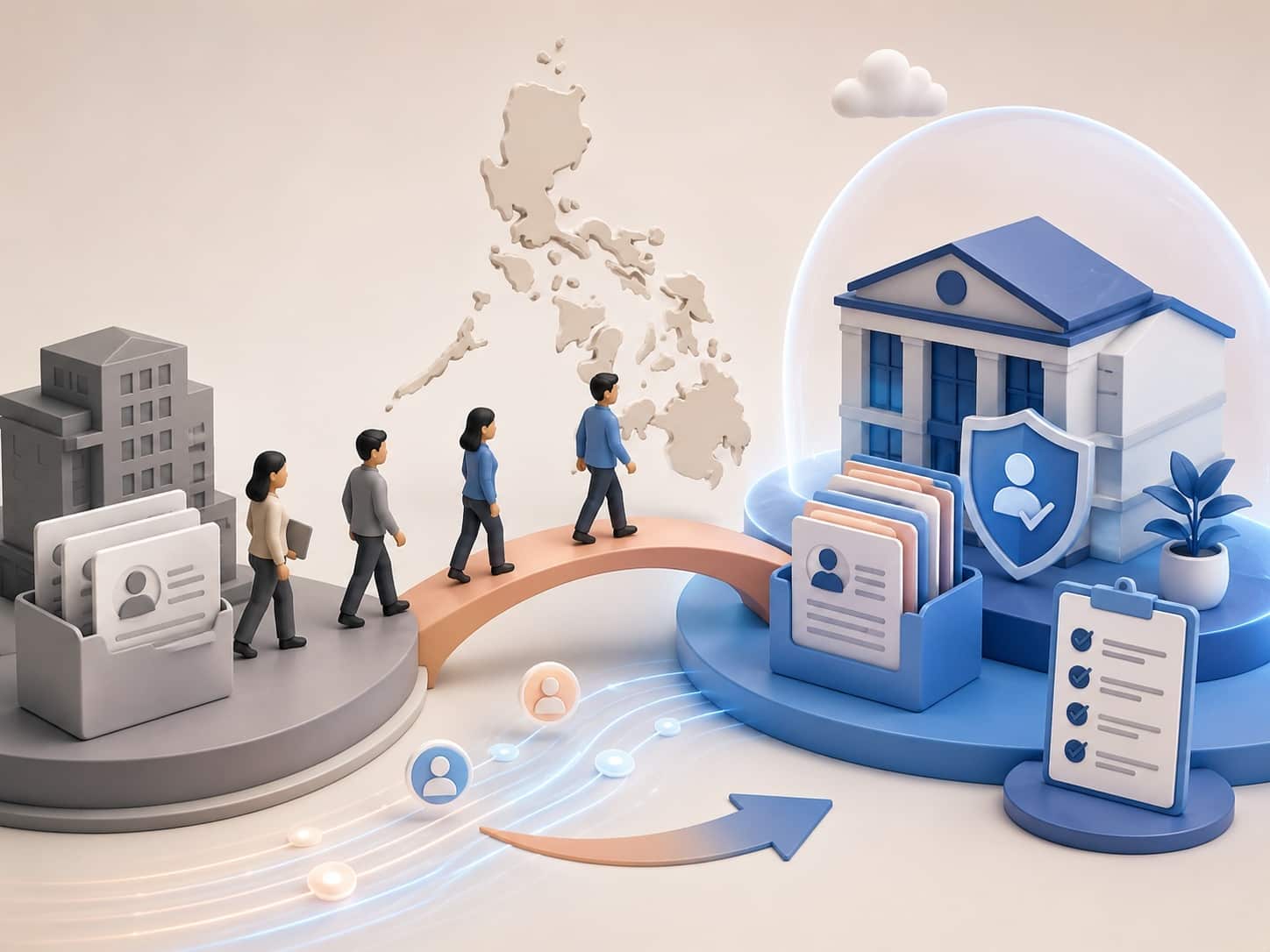
An EOR lets foreign companies hire employees in the Philippines without opening a local entity. The EOR becomes the local legal employer. The client company manages the employee’s daily work.
A compliant Philippines EOR should provide DOLE-aligned employment contracts, payroll records, payslips, SSS contribution evidence, PhilHealth contribution evidence, Pag-IBIG contribution evidence, 13th-month pay records, remittance receipts or summaries, and final pay or offboarding records.
For the full proof standard, see Philippines EOR Compliance.
Quick Answer
Companies implement Employer of Record in the Philippines by selecting a compliant local EOR provider, agreeing on salary and benefits, issuing a local employment contract through the EOR, setting up payroll and statutory contributions, onboarding the employee, and maintaining monthly payroll and compliance proof.
The current implementation model is simple:
Candidate selected → EOR employment contract → payroll and statutory setup → employee onboarding → monthly payroll and proof pack → ongoing HR and compliance support.
This model is best for companies that want Philippine employees but do not yet want to open a Philippine entity.
What Is an Employer of Record in the Philippines?
An Employer of Record is a local legal employer that hires employees in the Philippines on behalf of a foreign company.
The EOR handles employment administration and local compliance. The client company manages the employee’s daily work.
| Responsibility | Client Company | Philippines EOR |
| Selects the candidate | Yes | May support |
| Manages daily work | Yes | No |
| Sets role, KPIs, tools, and priorities | Yes | No |
| Employs the worker locally | No | Yes |
| Issues local employment contract | No | Yes |
| Runs payroll | No | Yes |
| Issues payslips | No | Yes |
| Handles SSS, PhilHealth, and Pag-IBIG | No | Yes |
| Handles 13th-month pay | No | Yes |
| Maintains employment records | Reviews | Yes |
| Supports HR and offboarding | Coordinates | Yes |
EOR is a practical bridge between contractor hiring and local entity setup.
When Should You Implement EOR in the Philippines?
Use EOR when:
- you want to hire Philippine employees without opening a local entity
- the role is ongoing, full-time, or employee-like
- the employee will use your tools and follow your management cadence
- you need payroll, payslips, contracts, and statutory benefits handled locally
- you want to reduce contractor misclassification risk
- you want to test the Philippines before entity setup
- you need a repeatable hiring process for remote employees
- you want compliance proof for finance, HR, investors, auditors, or buyers
EOR is usually better than contractor hiring when the person works like a long-term employee.
EOR is usually faster than entity setup when the company wants to hire now and does not yet need full local infrastructure.
When EOR Is Not the Right Fit
EOR may not be the right fit if:
- you only need a short-term independent contractor
- you want a vendor to manage the full business function
- you do not want to manage employees directly
- you need one global EOR platform across many countries immediately
- you already have a Philippine entity and local HR/payroll infrastructure
- you are ready to own all local employment, payroll, tax, HR, and compliance obligations directly
Use a BPO or outsourcing provider if you want a managed service. Use your own entity if the Philippine operation is large, permanent, locally managed, and strategically long-term.
EOR Implementation Roadmap
Step 1: Define the Hiring Plan
Before selecting an EOR, define the role and operating model.
| Planning Item | What to Decide |
| Role | Job title, responsibilities, seniority, required tools |
| Headcount | First hire, pilot team, or scaling plan |
| Salary | Target salary range and benefits package |
| Work setup | Remote, hybrid, office-based, shift, timezone |
| Management | Direct manager, team lead, escalation owner |
| Tools | Email, Slack, Teams, CRM, helpdesk, finance, code, analytics, task tools |
| Data access | Systems and permissions required |
| Start date | Target onboarding timeline |
| Hiring model | EOR, contractor, BPO, or local entity |
Do not implement EOR as an admin task only. The work model must be clear before employment setup begins.
Step 2: Choose the Right Philippines EOR Provider
A strong EOR provider should be able to explain and document how it handles local employment, payroll, statutory benefits, and compliance proof.
| EOR Evaluation Area | What to Ask |
| Legal employer | Does the provider employ workers through a Philippine entity? |
| Contract process | Can the provider show a sample employment contract? |
| Payroll process | Can the provider show sample payslips and payroll registers? |
| Statutory handling | How are SSS, PhilHealth, and Pag-IBIG calculated, remitted, and evidenced? |
| 13th-month pay | How is it accrued, calculated, paid, and documented? |
| Pricing | Is the EOR fee separated from salary, statutory costs, benefits, and equipment? |
| HR support | Who handles employee questions, leave, concerns, and offboarding? |
| Reporting | What monthly payroll and compliance reports are provided? |
| Scaling | Can the provider support 1 hire, 20 hires, and 100+ hires? |
| Exit process | How are final pay, documentation, and offboarding handled? |
If the EOR cannot show examples of compliance proof, do not rely on verbal assurances.
Step 3: Confirm the EOR Cost Model
EOR cost is not only the provider fee.
| Cost Layer | What It Means |
| Gross salary | Employee’s monthly salary |
| Employer statutory contributions | Employer-side payroll obligations |
| 13th-month pay | Mandatory annual pay for covered employees |
| Benefits / HMO | Optional or agreed benefits |
| Allowances | Internet, equipment, night shift, transport, or role-specific allowances |
| Equipment | Laptop, monitor, headset, approved device setup |
| EOR service fee | Provider fee for contracts, payroll, HR, payslips, and compliance administration |
| Tools | Client-side systems such as CRM, helpdesk, project tools, or code repositories |
| Management layer | Manager, team lead, QA, or internal function owner |
A clean EOR quote should separate salary, statutory costs, 13th-month pay, benefits, allowances, equipment, and provider fees.
Related page: EOR Pricing Philippines.
Step 4: Prepare the Employment Contract
The EOR should issue the local employment contract.
A strong contract process should confirm:
| Contract Item | Why It Matters |
| Legal employer | Shows the Philippine employer of record |
| Employee details | Confirms identity and employment record |
| Job title and duties | Aligns the worker to the role |
| Salary and pay cycle | Confirms compensation terms |
| Benefits | Documents statutory and optional benefits |
| Work setup | Remote, hybrid, office, shift, and location expectations |
| Probationary terms | Sets performance standards and review timing |
| Confidentiality | Protects company, client, and employee information |
| IP / work product | Protects code, content, SOPs, reports, documents, and output |
| Policies | Leave, holidays, conduct, equipment, data, and security |
| Termination and offboarding | Defines process, notice, final pay, and clearance |
The client company should provide role scope, operating expectations, and any required company policies. The EOR should adapt these into the local employment structure where appropriate.
Step 5: Set Up Statutory Benefits
Philippine employees generally require statutory contribution administration and payroll documentation.
| Statutory / Payroll Item | What the EOR Should Handle |
| SSS | Social security contribution setup, calculation, deduction, remittance, and records |
| PhilHealth | Health insurance contribution setup, calculation, deduction, remittance, and records |
| Pag-IBIG | Housing fund contribution setup, calculation, deduction, remittance, and records |
| 13th-month pay | Accrual, calculation, payment, and documentation |
| Tax withholding | Compensation withholding and year-end documentation where applicable |
| Payslips | Employee-facing payroll record |
| Payroll records | Employer-facing payroll register and reporting |
| Leave and holidays | Local leave and holiday administration |
| Final pay | Offboarding and exit settlement support |
The EOR should be able to show how each item is handled and documented.
Step 6: Set Up Payroll
Payroll setup should be completed before the employee begins paid work.
| Payroll Setup Item | What to Confirm |
| Pay cycle | Monthly or semi-monthly schedule |
| Cut-off dates | Deadline for salary changes, allowances, reimbursements, deductions |
| Gross salary | Contracted salary |
| Allowances | Internet, equipment, night shift, transport, or role-specific allowances |
| Deductions | Statutory and approved deductions |
| Employer contributions | Employer-side costs |
| Net pay | Final amount paid to employee |
| Payslip format | Employee-facing payroll record |
| Payroll register | Client-facing payroll report |
| Approval process | Client review and approval before release |
| Correction process | How payroll errors are fixed |
| Remittance evidence | How statutory contributions are evidenced |
The company should review payroll before release, especially for first payroll, salary changes, allowances, and leavers.
Step 7: Onboard the Employee
EOR onboarding and work onboarding are different.
| Onboarding Area | Owner |
| Employment contract | EOR |
| Employee records | EOR |
| Payroll setup | EOR |
| Statutory setup | EOR |
| HR policy explanation | EOR, with client input |
| Work tools | Client company |
| SOPs and training | Client company |
| KPIs and role expectations | Client company |
| Manager cadence | Client company |
| Data access controls | Client company |
| Security training | Client company, with EOR support if applicable |
A strong first week should include:
- signed employment documents
- payroll confirmation
- tool setup
- security rules
- role scorecard
- SOPs
- first-week tasks
- manager check-ins
- escalation path
- access-control review
Do not give broad access before the employee has completed security onboarding and a reviewed sample task.
Step 8: Maintain Monthly Payroll and Compliance Governance
EOR implementation is not finished after onboarding. Compliance must be maintained.
| Cadence | What to Review |
| Every payroll cycle | Salary, deductions, allowances, statutory costs, net pay, payroll approval |
| Monthly | Payroll register, payslips, headcount, benefits, open HR issues |
| Quarterly | Compliance proof pack, remittance evidence, benefits, access review |
| Annually | 13th-month pay, tax documentation, salary review, EOR vs entity review |
| On exit | Final pay, offboarding documents, clearance, access removal |
Governance matters more as headcount grows.
For larger teams, see Philippines EOR for Scaling Teams.
What Compliance Proof Should a Philippines EOR Provide?
A Philippines EOR should provide evidence, not only assurances.
| Proof Item | Why It Matters |
| Sample employment contract | Shows local employment structure |
| Signed employee records | Confirms role, salary, start date, and employment terms |
| Payroll register | Shows salary, deductions, allowances, employer costs, and net pay |
| Payslips | Shows employee-facing payroll transparency |
| SSS evidence or summary | Shows social security contribution handling |
| PhilHealth evidence or summary | Shows health insurance contribution handling |
| Pag-IBIG evidence or summary | Shows housing fund contribution handling |
| 13th-month pay record | Shows mandatory annual pay is tracked and paid |
| BIR withholding and year-end process | Shows tax withholding documentation where applicable |
| Leave and holiday records | Shows local HR administration |
| Offboarding and final pay records | Shows proper employee exit handling |
| HR escalation process | Shows how employee issues are handled |
| Data protection and access process | Shows how company and employee data are protected |
For the full checklist, see Philippines EOR Compliance.
Payroll Compliance in the Philippines
Payroll compliance should show what was earned, deducted, contributed, paid, and documented.
| Payroll Item | What Should Be Documented |
| Gross salary | Agreed salary for the pay period |
| Allowances | Internet, equipment, night shift, transport, or role-specific allowances |
| Deductions | Statutory and approved deductions |
| Employee contributions | Employee-side statutory deductions |
| Employer contributions | Employer-side statutory obligations |
| Tax withholding | Compensation withholding where applicable |
| Net pay | Final amount paid to employee |
| Payslip | Employee-facing payroll record |
| Payroll register | Employer-facing payroll record |
| 13th-month accrual | Monthly accrual and annual payment treatment |
| Remittance evidence | SSS, PhilHealth, Pag-IBIG, and tax records or summaries |
| Approval trail | Review and sign-off before payroll release |
At minimum, the client should receive payroll reports that clearly separate salary, statutory costs, benefits, allowances, and EOR fees.
Statutory Benefits for Employees in the Philippines
Philippines-based employees generally require statutory contribution and payroll administration.
| Statutory / Payroll Item | Why It Matters |
| SSS | Social security contribution administration |
| PhilHealth | Health insurance contribution administration |
| Pag-IBIG | Housing fund contribution administration |
| 13th-month pay | Mandatory annual pay for covered employees |
| Payslips | Payroll transparency and documentation |
| Payroll records | Finance, audit, and employee support |
| Leave records | Workforce planning and HR documentation |
| Final pay records | Clean offboarding |
Optional benefits may include HMO, allowances, bonuses, equipment, training support, and enhanced leave depending on the role and package.
The key question is not only whether statutory benefits are “included.” The provider should be able to show how they are calculated, paid, and documented.
EOR Implementation Timeline
A realistic EOR implementation timeline depends on provider readiness, employee documentation, role complexity, and payroll cut-offs.
| Stage | Typical Timeline |
| Role and hiring model confirmation | 1–3 days |
| EOR provider selection | 2–7 days |
| Candidate offer and salary confirmation | 1–3 days |
| Employment contract preparation | 2–5 days |
| Employee document collection | 2–5 days |
| Payroll and statutory setup | 3–7 days |
| Work onboarding and tool setup | 3–10 days |
Many simple EOR implementations can be completed in 1–3 weeks after candidate selection, depending on document readiness and payroll timing.
EOR vs Local Entity Setup
| Factor | EOR | Local Philippine Entity |
| Setup speed | Faster | Slower |
| Local legal employer | EOR | Your company |
| Payroll infrastructure | Provided by EOR | Built or outsourced by your company |
| HR compliance | Supported by EOR | Owned by your company |
| Best for | First hires, testing, early scaling, flexible expansion | Large permanent Philippine operations |
| Admin burden | Lower | Higher |
| Control | High day-to-day control | Full legal and operational control |
| Exit flexibility | Higher | Lower |
A common path is:
EOR → scaled EOR governance → entity review → entity setup or hybrid model
Related page: EOR vs Entity Setup.
EOR vs Contractor Implementation
| Factor | Contractor | EOR Employee |
| Best for | Short-term independent project work | Ongoing employee-like work |
| Employment contract | Usually none | Local employment contract |
| Payroll proof | Contractor invoice | Payslips and payroll records |
| Statutory benefits | Usually not handled | SSS, PhilHealth, Pag-IBIG, 13th-month handling |
| Misclassification risk | Higher if full-time and controlled | Lower when properly employed |
| Benefits | Usually none | Statutory and optional benefits |
| Offboarding | Contract-based | Local employment offboarding process |
| Best use case | Project work | Long-term team building |
If the worker is full-time, follows your schedule, uses your tools, reports to your managers, and performs ongoing work, EOR employment is usually cleaner than contractor hiring.
Related page: EOR vs Freelancer Philippines.
EOR Implementation Checklist
Use this checklist before launching an EOR hire.
| Checklist Item | Confirmed? |
| Role scope defined | |
| Salary range benchmarked | |
| Hiring model confirmed | |
| EOR provider selected | |
| EOR fee separated from salary and statutory costs | |
| Employment contract process confirmed | |
| SSS, PhilHealth, and Pag-IBIG handling confirmed | |
| 13th-month pay treatment confirmed | |
| Payroll cycle and cut-off dates confirmed | |
| Payslip and payroll register format reviewed | |
| Remittance evidence process confirmed | |
| Benefits and allowances documented | |
| Confidentiality and IP terms included | |
| Tool access plan prepared | |
| Security and data access rules prepared | |
| Manager and reporting cadence assigned | |
| Offboarding process documented | |
| Monthly governance cadence agreed |
Common EOR Implementation Mistakes
| Mistake | Result |
| Treating EOR as only payroll | Weak HR and compliance governance |
| Not defining the role clearly | Employee becomes a catch-all |
| Comparing only the EOR fee | Misses salary, statutory costs, benefits, tools, and equipment |
| Not asking for proof | Compliance claims cannot be verified |
| No payroll review process | Errors are missed |
| No 13th-month accrual | Surprise year-end cost |
| No statutory remittance evidence | SSS, PhilHealth, and Pag-IBIG proof is unclear |
| No access-control plan | Data, finance, CRM, or IP risk |
| No manager cadence | Remote work becomes invisible |
| No offboarding workflow | Final pay and system access risk |
EOR implementation works best when employment, payroll, work onboarding, data access, and governance are planned together.
Why Smart Outsourcing Solution Fits This Use Case
Smart Outsourcing Solution helps companies implement Employer of Record in the Philippines with a practical, compliance-backed process.
SOS can support:
- EOR implementation in the Philippines
- employment setup without local entity formation
- DOLE-aligned employment documentation
- payroll administration
- payroll records and payslips
- SSS, PhilHealth, and Pag-IBIG handling
- 13th-month pay handling
- remittance evidence or summaries
- HR and employee lifecycle support
- contractor-to-employee transitions
- onboarding and offboarding workflows
- scaling from first hire to larger teams
- transparent EOR support for remote roles
SOS is strongest when a company wants direct team control, local employment support, payroll visibility, and a Philippines-focused EOR partner.
When SOS May Not Be the Right Fit
SOS may not be the right fit if:
- you need one EOR platform across many countries immediately
- you want to outsource the entire business function instead of managing employees directly
- you only need short-term freelancers
- you are ready to open and operate your own Philippine entity
- you do not want to manage day-to-day work, tools, KPIs, or performance
EOR is best when the company wants dedicated employees with local employment infrastructure, not a fully managed outsourcing service.
FAQs
How do companies implement Employer of Record in the Philippines?
Companies implement Employer of Record in the Philippines by defining hiring needs, selecting an EOR provider, confirming salary and benefits, issuing a local employment contract through the EOR, setting up payroll and statutory contributions, onboarding the employee, and maintaining payroll and compliance proof.
Is Employer of Record legal in the Philippines?
Yes. Employer of Record services can operate legally when the provider uses a proper local employment structure and complies with Philippine employment, payroll, tax, and statutory contribution requirements.
Do companies need a Philippine entity to use EOR?
No. The main purpose of EOR is to let a company hire Philippine employees without opening its own Philippine entity. The EOR acts as the local legal employer while the client company manages the employee’s daily work.
How long does EOR implementation take in the Philippines?
Many EOR implementations can be completed in 1–3 weeks after candidate selection, depending on contract preparation, employee documentation, payroll setup, statutory setup, and payroll cut-off dates.
What compliance proof should a Philippines EOR provide?
A Philippines EOR should provide DOLE-aligned employment contracts, payroll registers, payslips, SSS contribution evidence, PhilHealth contribution evidence, Pag-IBIG contribution evidence, 13th-month pay records, remittance receipts or summaries, and final pay or offboarding records.
How does payroll compliance work in the Philippines?
Payroll compliance should show gross salary, allowances, deductions, employee and employer contributions, tax withholding where applicable, net pay, payslips, payroll registers, statutory evidence, 13th-month accrual and payment, and payroll approval trails.
What statutory benefits do Philippines employees need?
Philippine employees generally require statutory contribution administration for SSS, PhilHealth, and Pag-IBIG, plus 13th-month pay and proper payroll records. Depending on the role and employment package, employers may also provide HMO, allowances, bonuses, equipment, and training support.
What should be included in an EOR implementation checklist?
An EOR implementation checklist should include role scope, salary range, hiring model, provider selection, employment contract, payroll setup, statutory contribution setup, 13th-month pay treatment, payslip format, remittance evidence process, benefits, confidentiality, IP terms, tool access, security rules, manager cadence, and offboarding process.
When should a company move from EOR to its own Philippine entity?
A company should consider opening its own Philippine entity when the Philippine team is large, permanent, locally managed, and the company is ready to own payroll, HR, tax, legal, finance, and compliance infrastructure.
Can SOS help implement EOR in the Philippines?
Yes. SOS can support EOR implementation in the Philippines, including employment documentation, payroll, payslips, statutory administration, 13th-month handling, remittance evidence, contractor-to-employee transitions, onboarding, offboarding, and local HR support.
Implement EOR in the Philippines With Compliance Proof
Before starting, map the role, salary, hiring model, payroll setup, statutory benefits, access controls, and compliance proof.
Ask for:
- role scope
- hiring model
- salary benchmark
- EOR cost breakdown
- employment contract
- payroll register
- payslip sample
- SSS, PhilHealth, and Pag-IBIG handling
- 13th-month pay treatment
- remittance proof process
- confidentiality and IP terms
- access controls
- onboarding plan
- offboarding process
Read Philippines EOR Compliance
Compare EOR vs Entity Setup
Speak with a specialist and get a quote
Recommended SOS reads
- Philippines EOR Compliance
- Employer of Record Philippines
- Hiring in the Philippines: Startup Founder’s Guide
- Philippines EOR for Scaling Teams
- EOR Pricing Philippines
- Best EOR Providers Philippines
- Hire Employees in the Philippines Without Setting Up a Company
- EOR vs Entity Setup
- EOR vs Freelancer Philippines
- Convert Contractors to Employees Philippines
- Philippines Payroll Compliance Proof Pack
- Data Security & IP Protection in Offshore Teams
- Talent & Salary Benchmarks
- Salary Guide Philippines
- Hire Remote Teams in the Philippines